Purgatory and the Holy Souls: What the Church Teaches
A place of purification, not of damnation: what the Church teaches about purgatory and the Holy Souls, and how the faithful can help the departed.
On 2 November every Catholic priest may say three Holy Masses, one of them for all the faithful departed. Behind this privilege stands a doctrine that many now know only by name: purgatory. This guide explains what the Church teaches about purgatory and the Holy Souls, where the doctrine is found in Holy Scripture, what remains open, and how the faithful can help the departed.
- Purgatory (Latin purgatorium, from purgare, to cleanse) is the place or state of purification for the souls of those who have died in the grace of God but still have temporal punishment due to sin to pay.
- The Council of Florence (1439) and the Council of Trent (Session XXV, December 1563) teach that there is a purgatory and that the souls detained there are helped by the prayers of the faithful, above all by the Holy Sacrifice of the Mass.
- The Holy Souls are saved. They can no longer sin, but neither can they gain any further merit, and they depend on the intercession of the living.
- According to the 1962 Roman Missal, All Souls’ Day falls on 2 November. On this day every priest may say three Holy Masses, and the Church grants special indulgences for the departed.
What is purgatory?
Purgatory is the place or state in which the souls of the just are purified after death before they see God. It receives those who die in the grace of God but still bear venial sins or have not fully paid the temporal punishment for sins already forgiven.
The Roman Catechism, published in 1566 under Pope Pius V by decree of the Council of Trent, speaks of the fire of purgatory, in which the souls of the just are cleansed by temporal punishment, so that entrance may be opened to them into their eternal home, into which nothing defiled enters (Apoc 21:27).
The Council of Florence taught in 1439 that if those who are truly penitent die in the love of God before they have made satisfaction by worthy fruits of penance for what they have done and left undone, their souls are cleansed after death by purifying punishments. The Council of Trent confirmed this doctrine on 3 and 4 December 1563. As early as 1547 it had condemned the claim that, together with the guilt, every temporal punishment is remitted to the penitent sinner which would have to be discharged “either in this world, or in the next in Purgatory” (Session VI, Canon 30).
Where is purgatory in the Bible?
The word purgatory does not occur in the Bible, but the doctrine rests above all on two passages: the prayer for the fallen warriors in the Second Book of Machabees (12:43–46) and the word of St Paul that a man shall be saved “yet so as by fire” (1 Cor 3:15).
After the battle, Judas Machabeus had a collection made and sent silver to Jerusalem so that a sacrifice for sin might be offered for the fallen. Scripture judges this as follows:
“It is therefore a holy and wholesome thought to pray for the dead, that they may be loosed from sins.”
2 Macc 12:46, Douay-Rheims translation
In the First Epistle to the Corinthians the Apostle writes that every man’s work will be tried by fire on the day of the Lord. If any man’s work burn, “he shall suffer loss; but he himself shall be saved, yet so as by fire” (1 Cor 3:15). In his note, the German biblical scholar Joseph Franz Allioli explains that this refers to the cleansing fire after this life. The Council of Trent appeals both to Holy Scripture and to the ancient tradition of the Fathers.
Who are the Holy Souls?
The Holy Souls, called the “Poor Souls” (Arme Seelen) in German popular speech, are the departed in purgatory. They are saved and certain of heaven, yet they suffer as long as they are not with God, and they can no longer help themselves, because the time of meriting ends with death.
The 1917 Code of Canon Law speaks soberly of the “souls detained in purgatory” (animae in purgatorio detentae, can. 930). According to traditional theology, the Holy Souls know that they can no longer sin. St Bonaventure says that fear has therefore been taken from them. According to St Thomas Aquinas, their punishment consists in the delay of the vision of God and in the pain of fire.
Because they can no longer gain merit themselves, they depend on the help of the Church Militant, that is, the faithful on earth. How natural this was to the Christians of the age of the Fathers is shown by the request St Monica made of her sons shortly before her death at Ostia:
“This only I ask of you, that you remember me at the altar of the Lord, wherever you may be.”
Augustine, Confessions IX, 11, our translation from the Latin; German edition: Bibliothek der Kirchenväter, translated by Alfred Hofmann, Munich 1914
Is purgatory a real fire?
The Church has never defined as a dogma whether purgatory is a real fire. Only two things are settled: the state of purification exists, and the souls there are helped by the prayers and sacrifices of the faithful. Nothing more should be said about the punishment than is certain.
At the Council of Florence, Bessarion, one of the Greeks, denied a real fire, and the Greeks were assured that Rome had never issued a doctrinal decision on the matter. In the West the idea of a real fire is generally held; St Augustine and St Gregory the Great call the pain heavier than anything a man can suffer in this life. On 1 Cor 3:15 Allioli writes cautiously that the purification may be a fire “without on that account being our elemental fire” (translated from the German). The Council of Trent expressly ordered that difficult and subtle questions which do not serve edification be kept out of preaching to the unlearned people, and that uncertain things not be spread abroad.
How can we help the Holy Souls?
According to the Council of Trent, the Holy Souls are helped by the intercession of the living: Holy Masses, prayers, almsgiving and other works of piety. The Holy Sacrifice of the Mass, offered for the living and the dead, helps most. Indulgences applied to the departed are added to this.
Trent teaches that the Mass is also offered “for those departed in Christ who are not yet fully purified” (Session XXII, Chapter 2). If you would like to have a Holy Mass said for someone who has died, ask in the sacristy or at the parish office.
Under can. 930 of the 1917 Code, all indulgences granted by the Pope may be applied to the Holy Souls unless otherwise stated. Thus, according to the Raccolta, a third part of the Rosary, that is, five decades, carries an indulgence of five years (no. 360). You will find the prayers of the Rosary in our Rosary prayer companion. The best-known short prayer for the departed is the Requiem aeternam. It carries a partial indulgence of 300 days, which can be applied only to the departed:
Requiem aeternam dona eis, Domine; et lux perpetua luceat eis. Requiescant in pace. Amen.
Eternal rest grant unto them, O Lord, and let perpetual light shine upon them. May they rest in peace. Amen.
Latin: Preces et pia opera, Vatican 1952, no. 582. English: traditional version; German version in Schott, Das Meßbuch der heiligen Kirche, 1894, Litany of the Saints in the appendix

What happens on All Souls’ Day?
All Souls’ Day is the commemoration of all the faithful departed. According to the 1962 Roman Missal it is kept on 2 November, or on 3 November when 2 November falls on a Sunday. On All Souls’ Day every priest may say three Holy Masses, and the Church grants special indulgences for the departed.
St Odilo, Abbot of Cluny (died 1048), ordered the yearly commemoration of all the departed for the monasteries of his congregation; from there it passed to other orders and dioceses. Pope Benedict XV granted the privilege of three Masses to all priests on 10 August 1915: one Mass for an intention of the priest’s choosing, one for all the faithful departed, and one for the intention of the Pope.
Whoever visits a church on All Souls’ Day or on the following Sunday and prays for the departed can gain a plenary indulgence for the Holy Souls at each visit, with sacramental Confession, Holy Communion and six Our Fathers, Hail Marys and Glory Bes for the intention of the Pope.
During the octave of All Souls, the eight days from All Souls’ Day onwards, there is in addition a plenary indulgence each day for a devout visit to a cemetery with a prayer for the departed, under the usual conditions and applicable only to the departed. It was granted by Pope Pius XI (decree of the Sacred Penitentiary of 31 October 1934). What an indulgence is and which conditions apply is explained in our guide to indulgences.
“Nihil antiquius in Ecclesia Christi […], nihil concordius, nihil constantius quam pia defunctorum fratrum recordatio […].” Nothing in the Church of Christ is older, nothing more unanimous, nothing more constant than the devout remembrance of our departed brethren.
Sacred Penitentiary, decree of 31 October 1934, Acta Apostolicae Sedis 26 (1934), p. 606. Our translation
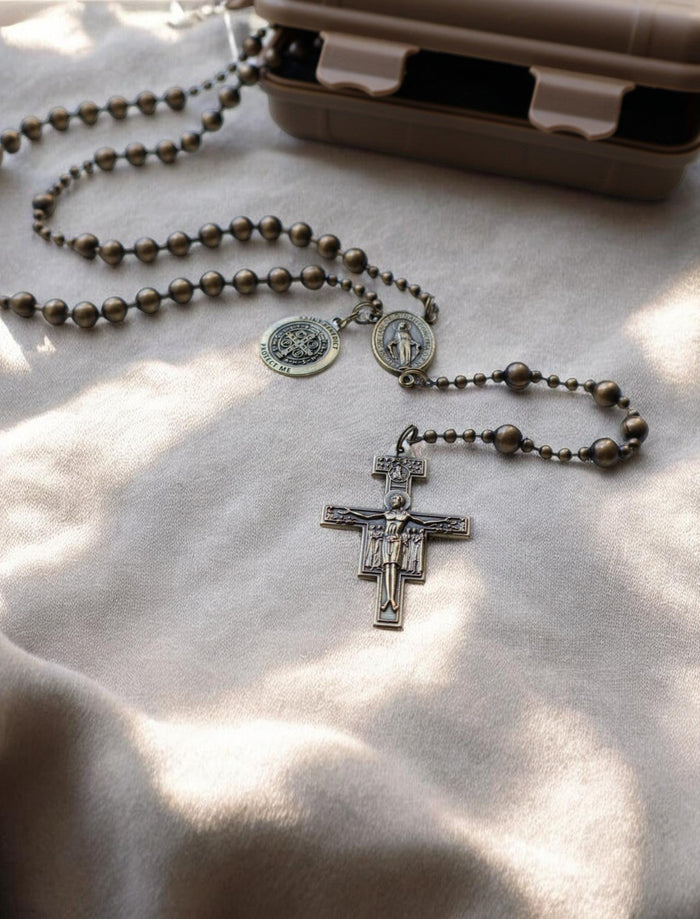
The Our Father beads of our memento mori rosary are shaped as skulls, a sign of transience. The rosary is knotted by hand from black 550 paracord, a 4 mm parachute cord. The skull beads are 10 mm metal beads, the centrepiece is the Miraculous Medal, and a Twelve Apostles crucifix hangs at the end. Including the cross, the rosary measures about 55 cm.
We knot the spacing between the beads so that your thumb fits comfortably in between. Closer or wider spacing is possible on request. Before use, have your rosary blessed by a priest.
 Mentioned in this article
Memento Mori Paracord Rosary
Hand-knotted from black 550 paracord, with skull beads, Miraculous Medal and Twelve Apostles crucifix.
View the rosary
You will find more rosaries, crosses and pictures for meditating on the Four Last Things in our Memento Mori collection, and all our hand-knotted pieces under Rosaries from our workshop.
Frequently asked questions about purgatory
Is purgatory the same as hell?
Purgatory is not hell. The Roman Catechism distinguishes hell, where the damned suffer eternally, from the place of purification, where the souls of the just are cleansed for a time. Whoever is in purgatory will certainly reach heaven.
How long does purgatory last?
The Church has not determined how long purgatory lasts. St Augustine teaches in The City of God (XXI, 13 and 16) that the temporal punishments after death end at the latest with the Last Judgement. Figures in days or years attached to indulgences do not denote time in purgatory but the measure of the ancient canonical penance.
Do the Holy Souls also pray for us?
Whether the Holy Souls pray for the living the Church has not decided. St Thomas Aquinas denies it; St Robert Bellarmine and St Alphonsus Liguori consider it possible. In her liturgy the Church herself does not invoke the souls in purgatory; she prays for them.
What helps a departed soul most?
According to the teaching of Trent, the Holy Sacrifice of the Mass helps a departed soul most. To this are added prayer, almsgiving and indulgences applied to the soul, and a visit to the grave with a prayer.
- Council of Trent, Session XXV (3/4 December 1563), Decretum de purgatorio; Session VI (1547), Canon 30; Session XXII (1562), Chapter 2. Latin text from Philip Schaff, Creeds of Christendom, vol. II. ccel.org
- Council of Florence, bull Laetentur coeli of 6 July 1439, from Denzinger, Enchiridion symbolorum, Freiburg 1911, no. 693.
- Roman Catechism (1566), Part I, Fifth Article of the Creed; English edition by Donovan, New York 1905. archive.org
- Die Heilige Schrift (German translation of the Bible by Joseph Franz Allioli), 4th edition, Landshut 1859: 2 Macc 12:43–46 (vol. 4) and 1 Cor 3:13–15 with notes (vol. 6).
- Augustine, Confessions IX, 11, Bibliothek der Kirchenväter (German edition), Munich 1914. bkv.unifr.ch
- Codex Iuris Canonici of 1917, can. 806 § 1, 911 and 930. codex-iuris-canonici.de
- Missale Romanum 1962, 2 November, In Commemoratione omnium fidelium defunctorum.
- Benedict XV, Constitution Incruentum Altaris of 10 August 1915, Acta Apostolicae Sedis 7 (1915), pp. 401–404.
- Sacred Penitentiary, decree of 31 October 1934, Acta Apostolicae Sedis 26 (1934), pp. 606 and 607.
- Preces et pia opera, Vatican 1952, nos. 582, 590–592; The Raccolta, Benziger 1943, nos. 360, 536, 544–546.
- Schott, Das Meßbuch der heiligen Kirche (German missal), 1894 edition, Litany of the Saints in the appendix. archive.org
- The Catholic Encyclopedia: Purgatory (1911), Indulgences (1910) and All Souls’ Day (1907). newadvent.org
Last checked on 19 October 2026.
The MarcellusOnlineShop workshop
We knot rosaries by hand in our workshop in Germany and write in our guide about prayers, devotional articles and the traditional Catholic faith.