Chi-Rho and In hoc signo vinces: the Sign of Constantine
An X with a P through it and the words In hoc signo vinces: what the Emperor Constantine saw before Rome in 312, as told by Lactantius and Eusebius, and what the Chi-Rho stands for.
In October of the year 312 Constantine’s army is encamped before Rome, opposite the Milvian Bridge over the Tiber. On the shields of his soldiers stands a sign made from the initial letters of the name of Christ. The Chi-Rho, the monogram of X and P, is the most common form of the monogram of Christ, and bound up with it is a Latin phrase that many know from patches and crosses: In hoc signo vinces. Following the two oldest accounts, this guide tells what the Emperor Constantine saw, what the sign means and what it stands for.
- The Chi-Rho is a monogram of Christ made of the Greek letters Chi (Χ) and Rho (Ρ), the first two letters of the name Christos.
- Lactantius reports that before the Battle of the Milvian Bridge in 312 Constantine was admonished in a dream to put the heavenly sign of God on the shields of his soldiers.
- Eusebius of Caesarea hands down a cross of light in the sky with the words “By this conquer”, in Greek τούτῳ νίκα. In Latin this became In hoc signo vinces: “In this sign you will conquer.”
- The imperial standard bearing the Chi-Rho is called the Labarum.
- The Chi-Rho is a profession of faith in Christ, not a lucky charm. The very priests who instructed Constantine interpreted the sign of the cross in his vision as the sign of victory over death.
What does the Chi-Rho mean?
The Chi-Rho is the monogram for the name of Christ. It joins the Greek letters Chi (Χ) and Rho (Ρ), with which the word Christos begins, into a single sign. Whoever wears or displays it is thus writing the name of the Redeemer in two letters.
The Catholic Encyclopedia of 1911 also calls this sign the Chrismon and describes it as the most common form of the monogram of Christ. In the course of the 4th century it appeared on public buildings, churches, sarcophagi, lamps, garments and household objects. It is frequent on funerary inscriptions, sometimes together with the letters Alpha and Omega from the Apocalypse, or with the fish, the dove or the palm branch. After 410, when Alaric had taken Rome, it became rare in Rome, while in the East it remained widespread for a long time.
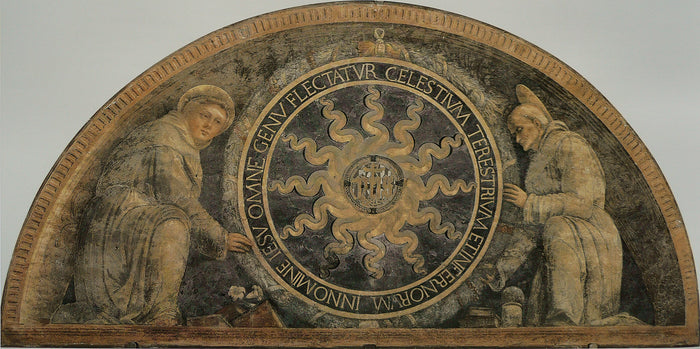
Tradition also knows other monograms of Christ, such as the IHS, formed from the name Jesus, and the sign made of I and X for Jesus Christ. Of these, the Chi-Rho was the most widespread in the 4th century.
What does “In hoc signo vinces” mean?
“In hoc signo vinces” means in English “In this sign you will conquer”. The phrase is the Latin rendering of the Greek words τούτῳ νίκα, “By this conquer”, which according to Eusebius the Emperor Constantine read in the sky before his campaign against Maxentius.
The Greek text contains a command: νίκα, conquer. The Latin form turns this into a promise in the future tense, vinces, “you will conquer”. In both versions the same sign is meant: the cross. The Catholic Encyclopedia of 1910, in its article on the Labarum, writes that the Greek words are “usually” translated In hoc signo vinces; the article on Constantine of 1908 gives the shorter form Hoc vinces, “in this you will conquer”.
On the patch from our collection of patches with Christian symbols, the phrase stands in the four corners around a red cross.
“About the hour of noon, when the day was already declining, he had seen with his own eyes, so the Emperor said, the victorious sign of the cross, formed of light, high in the sky above the sun, and with it the words: ‘By this conquer!’”
Eusebius of Caesarea, Life of Constantine I, 28, from the German translation by Johannes Maria Pfättisch and Andreas Bigelmair, Bibliothek der Kirchenväter, Munich 1913 (translated from the German)
What did Constantine see before the Battle of the Milvian Bridge?
There are two accounts of Constantine’s sign. Lactantius writes that Constantine was admonished in a dream to put the heavenly sign of God on the shields. Eusebius writes that at midday the Emperor saw a cross of light in the sky, and in the following night saw Christ in his sleep.
Lactantius wrote in his book On the Deaths of the Persecutors, chapter 44: “Constantine was admonished in a dream to have the heavenly sign of God placed on the shields and so to join battle. He did as he was commanded and, laying the letter X on its side and bending round its uppermost point, he marked Chr(ist) on the shields” (translated from the German). The Latin has caeleste signum dei, the heavenly sign of God.
Eusebius, Bishop of Caesarea, gives a fuller account and appeals to the Emperor himself. Constantine, he says, told him on oath “a long time afterwards” how he had prayed, had seen the cross of light and at night had beheld Christ with the same sign, who commanded him to make a likeness of it (Life of Constantine I, 28 to 30). The battle ended with the death of Maxentius in the Tiber. In the following year, 313, Constantine and Licinius granted Christians at Milan the free exercise of their faith.

What is the Labarum?
The Labarum is the standard that Constantine had made after his vision: a gilded spear shaft with a crossbar forming a cross, topped by a wreath of gold and precious stones bearing the Chi-Rho. It was carried before his armies and gave the monogram of Christ its name as the sign of Constantine.
Eusebius describes it precisely: in the wreath was “the sign of the Saviour’s name”, “two letters indicating the name of Christ by their initials, the P being crossed by the X in the middle”. The Emperor, he says, later also wore these letters on his helmet. From the crossbar hung a square cloth set with precious stones and gold, and above it were the golden busts of the Emperor and his sons (Life of Constantine I, 31). Eusebius assures us that he saw the standard himself (I, 30).
According to the Catholic Encyclopedia of 1910, the Labarum was a reworking of the older Roman cavalry standard; the pagan emblems were replaced by Christian ones. Fifty soldiers of the bodyguard guarded it, and all the legions received similar standards. Where the word labarum comes from has not been settled.
Did the Chi-Rho exist before Constantine?
According to the Catholic Encyclopedia of 1911, the Chi-Rho existed before Constantine, but rarely. On early Christian monuments it mostly appears as an abbreviation, for instance in a 3rd-century inscription in the Catacomb of Priscilla. It became the general emblem of Christians only through Constantine’s standard.
Scholars did not agree on this. The article on Constantine in the Catholic Encyclopedia of 1908 states that an earlier Christian use cannot be proved. The 1911 article on the monogram of Christ, on the other hand, considers well founded the view that the sign was already known to Christians, for how else could the Emperor have recognised it as a Christian sign? Likewise, the German translator of Eusebius notes in 1913, with Franz Joseph Dölger, that Eusebius knows nothing of the monogram having been unknown before.
The same encyclopedia points out that the joined letters Χ and Ρ already occur on pre-Christian coins, where they have no Christian meaning. The sign becomes Christian through the name for which it stands. How exactly Lactantius meant the letter on the shields is disputed; the encyclopedia calls his expression “somewhat obscure”.
Does the sign of Christ bring victory?
The Chi-Rho does not bring victory by its own power. It is a profession of faith in Christ. The priests who instructed Constantine after the vision explained to him that the sign of the cross he had seen was a symbol of immortality and the sign of the victory that Christ won over death.
So Eusebius records it in the Life of Constantine I, 32: the sign was “the symbol of immortality and the sign of the victory which he had once won over death” (translated from the German). The victory meant by the sign is the victory of the cross. The Church celebrates it on the feast of the Exaltation of the Holy Cross, in the 1962 calendar on 14 September. The Introit of the Holy Mass begins, after Galatians 6:14, with the words Nos autem gloriari oportet in Cruce Domini nostri Iesu Christi, “But it behoves us to glory in the Cross of our Lord Jesus Christ”.
St Thomas Aquinas draws the line with superstition precisely (Summa theologiae II-II, q. 96, a. 4). To carry sacred words and the sign of the cross on one’s person is permitted if one looks to God in doing so. It becomes superstitious when one places one’s hope in the manner of writing or of tying it on. A patch or a cross with the Chi-Rho is therefore a visible profession of faith, not a means that decides the outcome of a fight. Whoever has a rosary cross blessed makes it a sacramental; through sacramentals the Church obtains effects above all of a spiritual kind by virtue of her intercession (CIC 1917, can. 1144).
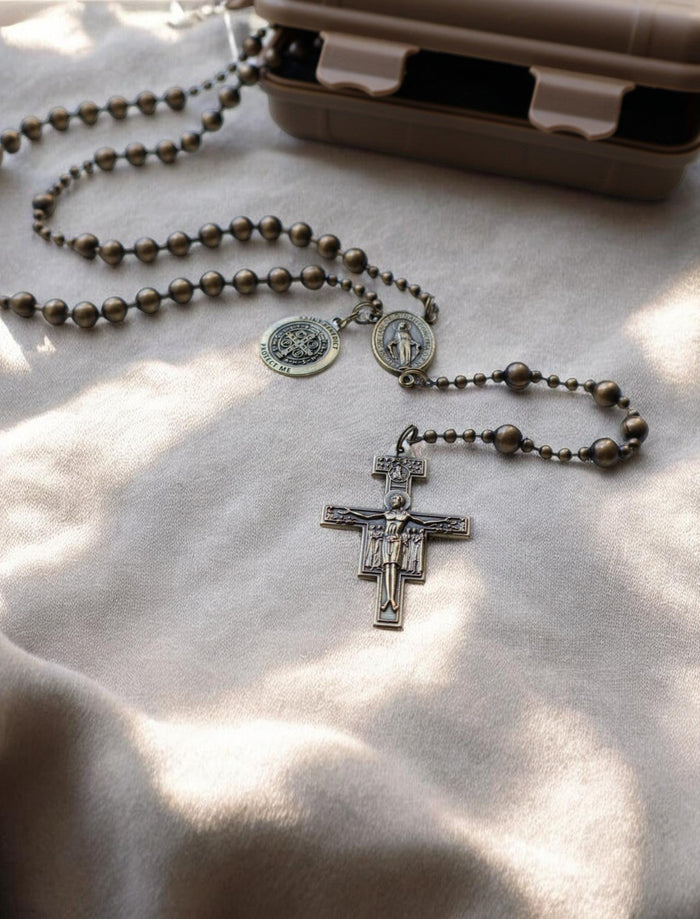
With us the Chi-Rho sits at the lower end of the cross that we designed ourselves for the DEUS VULT rosaries. The metal cross is 8 cm long and also bears INRI, Alpha and Omega, the Jerusalem cross and an inscription of the Templars.
The “In Hoc Signo Vinces” patch measures 5 × 8 cm and shows the inscription in the four corners around a red cross on a dark green ground. It has a hook-and-loop back and fits the hook-and-loop panel of our pouches for paracord rosaries.
 Mentioned in this article
In Hoc Signo Vinces Patch
Fabric patch, 5 × 8 cm, with hook-and-loop back for rosary pouches.
View the patch
 Mentioned in this article
DEUS VULT Gladius Rosary
Made of silver-grey 550 paracord, cross with Chi-Rho, Alpha and Omega.
View the rosary
Frequently asked questions about the Chi-Rho and In hoc signo vinces
Is the Chi-Rho the same as the monogram of Christ?
According to the Catholic Encyclopedia, the Chi-Rho is the most common form of the monogram of Christ. There are others besides, such as the IHS from the name Jesus and the combination of I and X for Jesus Christ. When people speak of “the” monogram of Christ, they usually mean the Chi-Rho.
Does IHS have anything to do with In hoc signo vinces?
IHS has nothing to do with In hoc signo vinces. IHS abbreviates the name Jesus: according to the article IHS in the Catholic Encyclopedia of 1910, from the Greek spelling; according to the article on the Holy Name of Jesus, from the medieval IHESUS. The encyclopedia calls the interpretation as “In Hoc Signo” a later invention.
When was the Battle of the Milvian Bridge?
The Battle of the Milvian Bridge took place at the end of October 312 before Rome. Lactantius links it with the anniversary of the day on which Maxentius had come to power. Maxentius drowned in the Tiber as he fled.
May one wear the Chi-Rho?
Any Christian may wear the Chi-Rho, as a pendant, on a rosary or on a patch. It is the name of Christ in two letters. Whoever wears it should treat it with the same reverence as any sign of the faith. To pray the Rosary, it is best to follow our prayer companion with all the prayers.
- Lactantius: De mortibus persecutorum, ch. 44. Latin text: thelatinlibrary.com. German: Von den Todesarten der Verfolger, translated by Aloys Hartl, Bibliothek der Kirchenväter, 1st series, vol. 36, Munich 1919; the quotation is translated from this German edition. bkv.unifr.ch
- Eusebius of Caesarea: Vita Constantini I, 27 to 32. German: Vier Bücher über das Leben des Kaisers Konstantin, translated by Johannes Maria Pfättisch and Andreas Bigelmair, Bibliothek der Kirchenväter, 1st series, vol. 9, Munich 1913; the quotations are translated from this German edition. bkv.unifr.ch
- Hassett, Maurice: Labarum (Chi-Rho). The Catholic Encyclopedia, vol. 8, New York 1910. newadvent.org
- Hassett, Maurice: Monogram of Christ. The Catholic Encyclopedia, vol. 10, New York 1911. newadvent.org
- Herbermann, Charles, and Grupp, Georg: Constantine the Great. The Catholic Encyclopedia, vol. 4, New York 1908. newadvent.org
- Maere, René: IHS. The Catholic Encyclopedia, vol. 7, New York 1910. newadvent.org
- Holweck, Frederick: Holy Name of Jesus. The Catholic Encyclopedia, vol. 7, New York 1910. newadvent.org
- Missale Romanum 1962: In Exaltatione S. Crucis, 14 September, Introit (Gal 6:14). Our translation.
- Thomas Aquinas: Summa theologiae II-II, q. 96, a. 4. corpusthomisticum.org
- Codex Iuris Canonici of 1917, can. 1144. codex-iuris-canonici.de
Last checked on 26 October 2026.
The workshop of MarcellusOnlineShop
We knot rosaries by hand in our workshop in Germany and write in the Guide about prayers, devotional articles and the traditional Catholic faith.