Christian Symbols: the Meaning of the Cross, Fish, Lamb and Anchor
Fish, anchor, lamb and Chi-Rho: how the first Christians expressed their faith in signs, what each symbol means and which ancient source attests it.
A fish on a gravestone in Rome, an anchor beside a name, two Greek letters on a soldier’s shield: the first Christians spoke in signs long before they showed the cross openly. Many of these Christian symbols are still with us today, on crosses, rosaries and patches, and not everyone knows what they mean. This guide explains eight well-known signs, from the cross through the Chi-Rho and IHS to the fish, the lamb, the dove, the anchor and Alpha and Omega, each with the source from which it comes.
- Christian symbols are images and letter signs with which Christians have professed their faith in Jesus Christ since the first centuries.
- Clement of Alexandria, born around 150, recommended to Christians a dove, a fish, a ship, a lyre or an anchor for their signet rings (Paedagogus III, 11).
- The Greek initial letters of “Jesus Christ, Son of God, Saviour” form the word Ichthys, fish (St Augustine, De civitate Dei XVIII, 23).
- Before the Battle of the Milvian Bridge, the Emperor Constantine had the Chi-Rho placed on his soldiers’ shields (Lactantius, De mortibus persecutorum 44); the Catholic Encyclopedia dates the battle to 28 October 312.
What are Christian symbols?
Christian symbols are images and letter signs with which Christians express their faith in Jesus Christ. The oldest date from the first three centuries, when the faithful were persecuted and did not show the cross openly. They include the fish, the anchor, the dove, the lamb and the monogram of Christ, the Chi-Rho.
An early written testimony comes from Clement of Alexandria. In the third book of his Paedagogus he advises that the signet rings of Christians should show a dove, a fish, a ship running before the wind, a lyre or a ship’s anchor, not images of idols and not swords. The Catholic Encyclopedia of 1909 concludes from this that Clement no longer needed to explain the meaning of the dove and the fish.
| Symbol | Meaning | Source |
|---|---|---|
| Cross | Redemption through the death of Christ | 1 Cor 1:18; Gal 6:14 |
| Chi-Rho ☧ | the first letters of Christos | Lactantius, De mortibus persecutorum 44 |
| IHS | abbreviation of the name Jesus | Catholic Encyclopedia 1910 |
| Fish | Jesus Christ, Son of God, Saviour | Augustine, De civitate Dei XVIII, 23 |
| Lamb | Christ as the sacrificial Lamb | Jn 1:29 |
| Dove | the Holy Ghost; the peace of the soul | Mt 3:16; Gen 8:11 |
| Anchor | hope of eternal salvation | Heb 6:19 |
| Α and Ω | Christ, the beginning and the end | Apoc 1:8; 22:13 |
What does the cross mean as a Christian symbol?
As a Christian symbol the cross is the sign of the Redemption, for on it Our Lord Jesus Christ died for the sins of the world. Yet it was shown openly only late: according to the Catholic Encyclopedia, the unveiled cross appears in Christian art only at the beginning of the 5th century.
Before then the faithful concealed the cross in other images, because the mockery of the pagans kept them from displaying it openly. According to the same source, one of the oldest veiled crosses is the anchor, which resembles a cross. It also counts the monograms of Christ among these veiled forms; in the course of the 4th century they gradually developed towards the cross. Today the cross stands before us in many forms: as a plain cross, as a crucifix with the corpus or as a Jerusalem cross with four small crosses in its angles. You will find a selection in our Crosses collection, and our guide to the crucifix explains the difference between a cross and a crucifix.
What do the Chi-Rho and IHS mean?
The Chi-Rho and IHS are monograms of Christ, that is, abbreviations of the name of Christ formed from letters. The Chi-Rho ☧ joins the Greek letters Chi and Rho, the first letters of Christos. IHS abbreviates the name Jesus, originally in Greek letters.
The Chi-Rho became well known through the Emperor Constantine. Lactantius reports that Constantine was directed in a dream to place the heavenly sign on his soldiers’ shields: an X with a vertical stroke bent round at the top, the sign of Christ (De mortibus persecutorum 44). Eusebius tells of a cross of light in the sky with the inscription “By this conquer”, usually rendered in Latin as In hoc signo vinces, “In this sign thou shalt conquer” (Vita Constantini I, 28). According to the Catholic Encyclopedia, the Battle of the Milvian Bridge took place on 28 October 312; Lactantius gives the sixth day before the Kalends of November, which by Roman reckoning is 27 October.
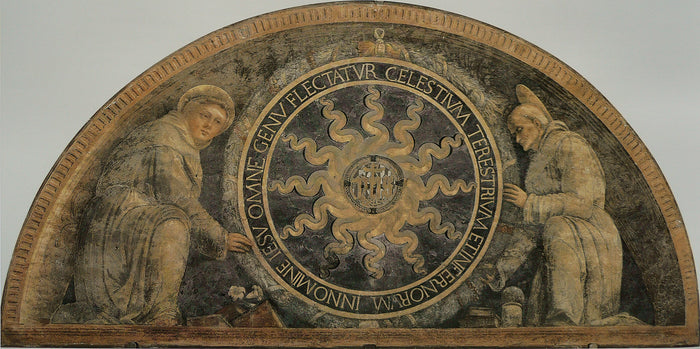
IHS spread above all in the late Middle Ages. St Bernardine of Siena showed the monogram to the faithful at the end of his sermons, and St Ignatius of Loyola adopted it in 1541 in his seal as General of the Society of Jesus. Sometimes a cross stands above the H, with three nails beneath. According to the Catholic Encyclopedia, the interpretation “Iesus Hominum Salvator”, Jesus, Saviour of men, is a mistaken reading. In the 1962 calendar the Church celebrates the Holy Name of Jesus on the Sunday between New Year’s Day and the Epiphany, otherwise on 2 January.
What does the fish mean in Christianity?
In Christianity the fish stands for Jesus Christ himself. The Greek word for fish, Ichthys, is formed from the initial letters of Iesous Christos Theou Yios Soter: “Jesus Christ, Son of God, Saviour”. Whoever drew the fish thereby professed his whole faith in a single image.
St Augustine explains the play on words in the 18th book of his City of God and adds an interpretation: Christ is called a fish because in the abyss of this mortality, as in the depths of the waters, he could remain alive, that is, without sin. Tertullian extends the line to Baptism: nos pisciculi secundum ichthyn nostrum Iesum Christum in aqua nascimur, “we little fishes are born in water, after the example of our Fish, Jesus Christ” (De baptismo 1). According to the Catholic Encyclopedia, the fish was already painted in the first decades of the 2nd century in the chapels of the sacraments in the Catacomb of St Callixtus.
“In quo nomine mystice intellegitur Christus, eo quod in huius mortalitatis abysso velut in aquarum profunditate vivus, hoc est sine peccato, esse potuerit.”
St Augustine, De civitate Dei XVIII, 23, with u standardised to v in the spelling. English in the text above
What do the lamb and the dove mean?
In Christianity the lamb stands for Christ, who gave himself as a sacrifice for the sins of the world; St John the Baptist called him “the Lamb of God”. The dove stands for the Holy Ghost, who descended like a dove at Our Lord’s baptism, and on graves for the peace of the soul.
The Baptist’s words are found in Jn 1:29: Ecce agnus Dei, ecce qui tollit peccatum mundi, in the Douay-Rheims version “Behold the Lamb of God, behold him who taketh away the sin of the world”. The Church repeats them at Holy Mass before Holy Communion: Agnus Dei, qui tollis peccata mundi: miserere nobis, “Lamb of God, who takest away the sins of the world, have mercy on us”. According to the Catholic Encyclopedia, in the apse mosaics of the basilicas after Constantine Christ often stood as a lamb on a mountain from which four rivers flow, an image of the four Evangelists.
The dove goes back to two passages. After his baptism Our Lord saw the Spirit of God descending like a dove (Mt 3:16), and after the Flood the dove returned to Noah with the olive branch (Gen 8:11). On old gravestones the dove therefore often carries an olive branch and, according to the Catholic Encyclopedia, signifies the peace of the departed soul.
What do the anchor and Alpha and Omega mean?
The anchor signifies the hope of eternal salvation, after Heb 6:19, where hope is called “an anchor of the soul, sure and firm”. Alpha and Omega, the first and the last letters of the Greek alphabet, signify Christ as the beginning and the end of all things.
Allioli explains the passage in Hebrews thus: “The hope of eternal happiness is for the Christian what the anchor is for the ship” (translated from the German). According to the Catholic Encyclopedia of 1907, the anchor is among the oldest Christian symbols; in the Catacomb of St Priscilla alone some seventy examples were found from the period before the 4th century, often beside words such as pax tecum, “peace be with thee”, or in pace, “in peace”.
Alpha and Omega go back to the Apocalypse. In Apoc 22:13 the Lord says: Ego sum alpha et omega, primus et novissimus, principium et finis, in the Douay-Rheims version “I am Alpha and Omega, the first and the last, the beginning and the end”. In his note on Apoc 1:8, Allioli explains that Christ is the one through whom all things were created, and at the same time the goal and end of all created things.

May you wear Christian symbols as jewellery or patches?
You may wear Christian symbols as a pendant, on a rosary or as a patch, as a visible profession of faith in Christ. According to St Thomas Aquinas, wearing sacred words becomes superstitious when one trusts in the manner of writing or binding rather than in God; the same applies to signs.
Thomas holds that one may carry sacred words about one’s person if one looks solely to reverence for God; he expressly names the sign of the cross as permitted (Summa theologiae II-II, q. 96, a. 4). A sign such as the fish or the Chi-Rho is therefore not a lucky charm, but a word of faith in the form of an image. If an object is blessed, the 1917 Code of Canon Law also applies: blessed objects are to be treated with reverence and not put to profane use or to a use foreign to them (can. 1150).
If you would like to wear such a sign on your rosary pouch or rucksack, you will find the Jerusalem cross and In hoc signo vinces designs in our Patches collection. The cross with Alpha and Omega and the Chi-Rho is carried by our Gladius rosary from the Deus Vult series; Deus vult means “God wills it”. How to begin praying at the cross of a rosary is shown in our prayer companion for the Rosary.
We designed the 8 cm metal cross of our Deus Vult Gladius rosary ourselves, so that it unites several ancient signs: at the top INRI, the inscription on the Cross, Iesus Nazarenus Rex Iudaeorum, “Jesus of Nazareth, King of the Jews”; Alpha and Omega to the left and right; the Chi-Rho at the foot; and the Jerusalem cross as well. The centrepiece, with “Deus Vult” on the front and the Jerusalem cross on the back, is also our own design.
The In Hoc Signo Vinces and Jerusalem Cross patches measure 5 by 8 cm and have a hook-and-loop backing. They fit the hook-and-loop panels of our pouches for paracord rosaries and can be moved at any time.
 Mentioned in this article
In Hoc Signo Vinces patch
Red cross with the inscription from Constantine’s vision, 5 by 8 cm, hook-and-loop backing.
View the patch
 Mentioned in this article
DEUS VULT Gladius rosary
Silver-grey 550 paracord and our own cross with INRI, Alpha and Omega and the Chi-Rho.
View the rosary
Frequently asked questions about Christian symbols
What is the oldest Christian symbol?
The anchor and the fish are among the oldest Christian symbols. The Catholic Encyclopedia mentions a tomb inscription with an anchor in the Catacomb of Domitilla from the end of the 1st century; it counts the fish among the most important signs of the early Christians.
What do the three nails beneath IHS mean?
The three nails beneath IHS are the nails of the Crucifixion. According to the Catholic Encyclopedia, this form arose towards the end of the Middle Ages, sometimes with a cross above the H and a ring of rays around the whole sign.
Why do patches show a cross with four small crosses?
The cross with four small crosses is the Jerusalem cross. Our product description interprets the five crosses as the five wounds of Christ, in his hands, his feet and his side.
What does Alpha and Omega on a cross mean?
Alpha and Omega on a cross profess Christ as the beginning and the end. The Catholic Encyclopedia attests the sign in Christian art from the 4th century, inspired by the Apocalypse.
- Biblia Sacra Vulgata: Gen 8:11; Mt 3:16; Jn 1:29; 1 Cor 1:18; Gal 6:14; Heb 6:19; Apoc 1:8; Apoc 22:13. drbo.org. Allioli, Die Heilige Schrift (in German), vol. 5 (Landshut 1839) and vol. 6 (Landshut 1859). archive.org
- Augustine: De civitate Dei XVIII, 23. thelatinlibrary.com
- Tertullian: De baptismo, ch. 1. thelatinlibrary.com
- Clement of Alexandria: Paedagogus III, 11. Lactantius: De mortibus persecutorum 44. Eusebius: Vita Constantini I, 28 to 31. newadvent.org
- St Thomas Aquinas: Summa theologiae II-II, q. 96, a. 4. Codex Iuris Canonici of 1917, can. 1150.
- Missale Romanum, Editio typica 1962: Ordo Missae (Agnus Dei); Sanctissimi Nominis Iesu. archive.org
- Catholic Encyclopedia: Alpha and Omega, The Anchor (1907); Archaeology of the Cross and Crucifix (1908); Symbolism of the Fish, Dove (1909); IHS, Labarum, Lamb (1910); Monogram of Christ (1911). newadvent.org
Last checked on 26 October 2026.
The MarcellusOnlineShop workshop
We knot rosaries by hand in our workshop in Germany and write in the Guide about prayers, devotional articles and the traditional Catholic faith.