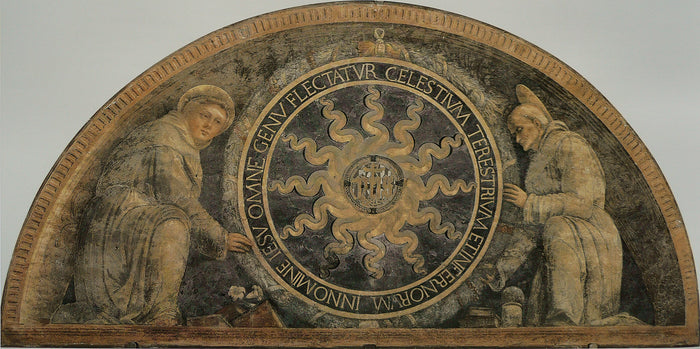
Holy Pictures of Saints: What the Church Teaches and How to Choose the Right One
From the Council of Nicaea to the prayer corner: why Catholics honour holy pictures, why this is not idolatry and how to choose the right picture for your home.
St Joseph above the bed, St Michael the Archangel in the hallway, a small picture of Our Lady in the kitchen: the holy picture has belonged to the Catholic home for centuries, and yet many today ask: may images be venerated, which picture suits whom, and where should it hang? This guide explains what the Church teaches about sacred images, from the Council of Nicaea in 787 to the 1917 Code of Canon Law, and how to choose a holy picture for your home.
- A holy picture is a painted, printed or carved image of Christ, of Our Lady or of a saint, meant to move us to prayer and imitation.
- In 787 the Second Council of Nicaea decreed that sacred images be set up “in houses and by the wayside” as well. According to its teaching, the honour paid to the image passes to its prototype.
- In 1563 the Council of Trent confirmed: images are venerated not because any divinity or power dwells in them, but because the honour passes to the person they represent.
- For the home, the most suitable are Christ, Our Lady, your patron saint and the patrons of the family.
What is a holy picture?
A holy picture is a representation of Christ, of the Blessed Virgin Mary, of an angel or of a saint, whether painted, printed or shaped as a statue. The faithful hang holy pictures in churches and homes so that, on seeing them, they think of the person represented and ask for his or her intercession.
In December 1563 the Council of Trent names three groups: images of Christ, of the Virgin Mother of God and of the other saints. The Rituale Romanum, the Roman Ritual containing the blessings of the Church, blesses images that are “sculpted or painted”, and so makes no distinction between painting and statue. A crucifix is in this sense also a sacred image, namely the image of the crucified Saviour.
In our range you will find pictures of the saints, from St Joseph and St Benedict to the Curé of Ars, as well as pictures of Christ and of Our Lady.
Why do Catholics venerate holy pictures?
Catholics venerate holy pictures because, according to the Church’s teaching, the honour paid to the image passes to the person represented. The image reminds us of Christ and the saints, awakens our love for them and sets their example before our eyes, so that the faithful may order their lives by it.
The Second Council of Nicaea formulated this teaching in the year 787 against the iconoclasts. It decreed that the venerable and holy images be set up like the image of the Cross: in churches, on sacred vessels and vestments, on walls and on panels, “in houses and by the wayside”. The more often they are contemplated, the more one is reminded of their prototypes and drawn towards them. True adoration (latria), however, is due to the divine nature alone.
The Council of Trent took this up in 1563. Through the images of the mysteries of our Redemption the people are instructed in the articles of faith, and the examples of the saints are set before the eyes of the faithful, so that they may give thanks to God and order their lives after the saints.
“For the honour paid to the image passes to its prototype, and whoever venerates the image venerates in it the person of the one depicted.”
Second Council of Nicaea (787), definition on sacred images; our translation from the Latin in Denzinger, Enchiridion symbolorum, no. 302
Is the veneration of holy pictures idolatry?
The veneration of holy pictures is not idolatry, because the Church does not venerate the image as a thing but the person represented. It would be idolatry to suppose a divine power in the image or to place one’s trust in it. The image itself she honours only as a likeness.
The Roman Catechism, published by order of Pope St Pius V, explains under the First Commandment that the commandment does not forbid the art of painting and sculpture. Holy Scripture itself tells of images made at God’s command, such as the Cherubim and the brazen serpent. What is forbidden is to venerate images as gods, to ascribe divine power to them or to put one’s trust in them, as the heathens did.
St Thomas Aquinas makes a finer distinction using the example of the image of Christ: to the image as a thing, such as painted or carved wood, no reverence is due. Reverence is shown to it only in so far as it is an image (Summa theologiae III, q. 25, a. 3). The 1917 Code of Canon Law says the same briefly: images are owed a veneration that refers to the person represented (can. 1255 § 2).
Which holy picture suits you?
Which holy picture suits you depends on your relationship to the saint. First come an image of Christ and of Our Lady. Then come the patron saint whose name you received at baptism, the patrons of your family, your profession or your town, and saints whose lives are an example to you.
The patron saint has a firm place here. The 1917 Code of Canon Law obliges parish priests to see that the child being baptised receives a Christian name; if this is not possible, the priest adds the name of a saint to the name chosen by the parents and enters both in the baptismal register (can. 761). Likewise it calls it praiseworthy for nations, dioceses, ecclesiastical provinces, confraternities, religious orders and other communities to choose saints as patrons, to be confirmed by the Apostolic See (can. 1278). Many families do something similar on a small scale and honour a patron of the house. The saint’s feast is a good day to hang up the picture or give it as a gift.
| Saint | Feast 1962 | Title in the Missal |
|---|---|---|
| Joseph | 19 March | Spouse of the Blessed Virgin Mary, Confessor, Patron of the Universal Church |
| Benedict | 21 March | Abbot |
| Thomas | 7 March | Thomas Aquinas, Confessor and Doctor of the Church |
| Augustine | 28 Aug. | Bishop, Confessor and Doctor of the Church |
| Thérèse | 3 Oct. | Thérèse of the Child Jesus, Virgin |
| Vianney | 8 Aug. | John Mary Vianney, Confessor |
| Michael | 29 Sept. | Archangel (feast of the dedication of his church) |
The feast days are given as in the calendar of the Missale Romanum, the Roman Missal, of 1962. You will find all the motifs among our Catholic wall pictures.
Where should you hang a holy picture?
A holy picture is hung in a place where it is seen and where one can pray: in the prayer corner (Herrgottswinkel), above the home altar, above the bed or beside the front door. What matters is a worthy place, free of everyday clutter.
Many families gather their pictures in one spot, so that a small place of prayer comes into being: the cross in the centre, beside it Our Lady and the patron saints. How to arrange such a place is described in our guide to the prayer corner. A picture of the Guardian Angel or of St Joseph suits a child’s room well.
The Council of Trent requires dignity for sacred images: they are not to be painted or adorned “with wanton beauty”. For the home this means choosing a motif that leads to prayer and does not merely decorate. You will find an image of Christ among our pictures of Jesus Christ.
Does a holy picture have to be blessed?
A holy picture for the home need not be blessed, but having it blessed is a pious custom. The Rituale Romanum allows any priest to bless an image of Christ, of Our Lady or of a saint privately and without the permission of the Ordinary.
The blessing consists of short versicles, a prayer and the sprinkling with holy water. When images exposed for public veneration are blessed solemnly, this blessing is reserved to the Ordinary, who may, however, delegate it to any priest (CIC 1917, can. 1279 § 4). After the blessing the picture is a blessed object and is treated with reverence, even if it is privately owned (can. 1150).
Omnipotens sempiterne Deus, qui Sanctorum tuorum imagines (sive effigies) sculpi, aut pingi non reprobas, ut quoties illas oculis corporis intuemur, toties eorum actus et sanctitatem ad imitandum memoriae oculis meditemur …
Almighty, everlasting God, who dost not disapprove that images (or likenesses) of Thy saints be sculpted or painted, so that as often as we behold them with the eyes of the body, so often we may meditate with the eyes of memory on their deeds and holiness, in order to imitate them …
Rituale Romanum, Tit. VIII, cap. 25, blessing of an image (Regensburg edition 1937); our translation of the opening from the Latin
Our wall pictures, such as St Joseph with the Child Jesus, St Benedict or St Michael the Archangel, are printed on matt photographic card of 216 to 270 g/m², mostly in the sizes A5 (14.8 × 21 cm) and A4 (21 × 29.7 cm). No frame is included, so that you can frame the picture to suit your prayer corner or home altar.
We do not roll the pictures but as a rule place them by hand in a protective envelope. So the picture reaches you flat.
 Mentioned in this article
St Joseph with the Child Jesus
Wall picture of St Joseph with the Child Jesus, printed on matt photographic card, without frame.
View the wall picture
Frequently asked questions about holy pictures
May an old holy picture be thrown away?
A blessed holy picture is not put in the household rubbish, for blessed things are to be treated with reverence and not put to profane use (CIC 1917, can. 1150). Ask your priest how it may be disposed of worthily. Out of reverence for the person depicted, an unblessed picture should be treated in the same way.
Which holy picture makes a good baptism gift?
For a baptism, a picture of the patron saint whose name the child receives in baptism is especially fitting. If the name belongs to no saint, a picture of Our Lady, of St Joseph or of the Guardian Angel is a good choice.
Is a statue of a saint also a holy picture?
For the Church a statue of a saint belongs among the sacred images just as much as a painting; the Ritual blesses both with the same prayer. You will find a selection among our statues of saints.
May holy pictures hang in the bedroom?
Holy pictures may hang in the bedroom. Many families hang a cross or a picture of Our Lady above the bed and say their evening prayers before it. There is no rule about the place for the home.
- Second Council of Nicaea (787), definition on sacred images, Latin after H. Denzinger: Enchiridion symbolorum, Freiburg 1911, no. 302. archive.org
- Council of Trent, Session XXV (December 1563), Decree on the invocation, veneration and relics of saints, and on sacred images; Latin after Ph. Schaff, Creeds of Christendom, vol. II (1877). ccel.org
- Römischer Katechismus nach dem Beschlusse des Conciliums von Trient (the Roman Catechism in German), Part III, explanation of the First Commandment; German edition, Passau (Pleuger), new edition, 1853 according to archive.org. archive.org
- St Thomas Aquinas: Summa theologiae III, q. 25, a. 3. newadvent.org
- Codex Iuris Canonici of 1917, can. 761, 1150, 1255, 1278 and 1279. codex-iuris-canonici.de
- Rituale Romanum, Tit. VIII, cap. 25: solemn blessing of an image of Christ, of the Blessed Virgin or of a saint; Regensburg 1937.
- Missale Romanum 1962, Kalendarium.
Last checked on 26 October 2026.
The MarcellusOnlineShop workshop
We knot rosaries by hand in our workshop in Germany and write in our Guide about prayers, devotional articles and the traditional Catholic faith.