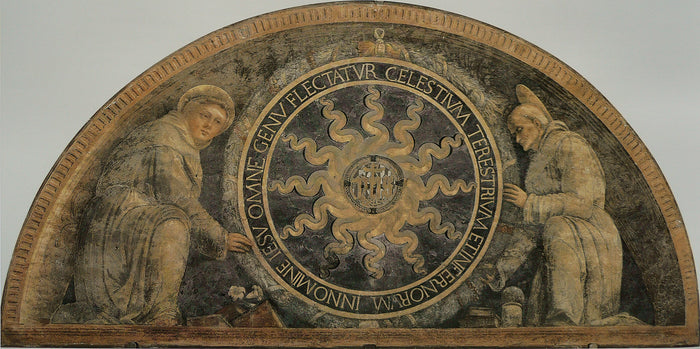
INRI: the Meaning of the Inscription on the Cross of Christ
Four letters above the head of the Crucified: what INRI means, why Pilate had the inscription written in three languages and where the title of the Cross is venerated today.
Above almost every crucifix there is a small plaque with four letters: INRI. You see it on the rosary, on the wall cross and on the altar, and yet many people do not know exactly what INRI means. The answer is in the Gospel of St John, word for word, and it is older than any crucifix. This guide explains the four letters, the Bible passage according to the Vulgate, the three languages of the inscription, the answer of Pilate and the relic venerated in Rome as the title of the Cross.
- INRI is the abbreviation of the Latin inscription on the Cross, Iesus Nazarenus Rex Iudaeorum: “Jesus of Nazareth, King of the Jews”.
- According to Jn 19:19–20, Pontius Pilate had the inscription placed over the Cross, in Hebrew, Greek and Latin.
- When the chief priests demanded a change, Pilate answered: Quod scripsi, scripsi, “What I have written, I have written” (Jn 19:22).
- According to tradition, the title of the Cross is preserved in the Basilica of Santa Croce in Gerusalemme in Rome (Catholic Encyclopedia, 1912).
What does INRI mean?
INRI stands for Iesus Nazarenus Rex Iudaeorum, in English “Jesus of Nazareth, King of the Jews”. The four letters abbreviate the Latin version of the inscription that Pontius Pilate had placed over the Cross of Our Lord Jesus Christ.
| Letter | Latin | English |
|---|---|---|
| I | Iesus | Jesus |
| N | Nazarenus | of Nazareth, literally “the Nazarene” |
| R | Rex | King |
| I | Iudaeorum | of the Jews |
The sentence stands in exactly this spelling in the 1962 Roman Missal: on Good Friday the Passion according to St John is sung, and in the middle of it we hear Erat autem scriptum: Iesus Nazarenus, Rex Iudaeorum. Latin originally wrote the initial sound of these words with an I; that is also how it stands in the 1962 Missal, and so the abbreviation is INRI and not INRJ. The Douay-Rheims Bible renders the words as “Jesus of Nazareth, the King of the Jews”.
Where is INRI found in the Bible?
The inscription INRI goes back to the Gospel of St John, chapter 19, verse 19. All four Gospels report the inscription on the Cross, but only St John gives the name Nazarenus. The four letters come from his Latin wording.
The Vulgate says: Scripsit autem et titulum Pilatus, et posuit super crucem. Erat autem scriptum: Jesus Nazarenus, Rex Judaeorum. The Douay-Rheims version renders it: “And Pilate wrote a title also, and he put it upon the cross. And the writing was: Jesus of Nazareth, the King of the Jews.” The Latin word titulus means a board bearing an inscription. In his note on Mt 27:37 the German biblical scholar Joseph Franz Allioli explains the custom at executions: a soldier carried a white board with the name and the offence of the condemned man, which was then nailed to the cross.
| Passage | Vulgate | Douay-Rheims |
|---|---|---|
| Mt 27:37 | Hic est Jesus rex Judaeorum | This is Jesus the King of the Jews |
| Mk 15:26 | Rex Judaeorum | The King of the Jews |
| Lk 23:38 | Hic est rex Judaeorum | This is the King of the Jews |
| Jn 19:19 | Jesus Nazarenus, Rex Judaeorum | Jesus of Nazareth, the King of the Jews |
The Catholic Encyclopedia of 1908 likewise sets the four versions side by side and calls St John an eyewitness. According to Jn 19:26, the disciple whom the Lord loved stood beneath the Cross with the Blessed Virgin Mary; tradition sees in him the Evangelist John.
Why was the inscription written in three languages?
According to Jn 19:20, the inscription on the Cross was written in Hebrew, Greek and Latin, so that, as Allioli explains, everyone could read it. Hebrew was the language of the land, Latin that of the Roman rulers, and Greek that of the Jews from abroad who were in Jerusalem for the feast.
This is how Allioli explains it in his note on the passage. St John adds that “many of the Jews” read the title, because the place of the crucifixion was nigh to the city. St Luke names the three scripts in a different order: litteris graecis, et latinis, et hebraicis (Lk 23:38).
St Augustine interprets the three languages in his 117th Tractate on the Gospel of John: Hebrew for the Jews, who gloried in the Law of God; Greek for the wise among the Gentiles; Latin for the Romans, who at that time ruled over almost every land. Allioli adds that in these three languages all the other peoples are included as well.
“The holy Fathers believe that this was meant to indicate that Christ died for all and calls all peoples to his faith.”
Joseph Franz Allioli, note on Jn 19:20 (vol. 5, Landshut 1839), translated from the German
Did Pilate mean INRI as mockery?
Pilate meant the inscription INRI as a statement of the charge: the condemned man had claimed to be King of the Jews. According to Allioli, however, by divine permission Pilate worded it in such a way that he thereby wrote down the true dignity of Our Lord and the true reason for his death.
The chief priests noticed what stood on the board and demanded a change: “Write not, The King of the Jews; but that he said, I am the King of the Jews.” Pilate refused: “What I have written, I have written” (Jn 19:21–22, Douay-Rheims). In the Vulgate it is only three words: Quod scripsi, scripsi.
St Augustine sees a providential design in this. What Pilate had written remained written, because the Lord had said what he had said. Christ, moreover, is King not only of the Jews but also of the Gentiles. The Church sings this truth in the hymn Vexilla Regis from the Breviary: Regnavit a ligno Deus, “God has reigned from the tree”.
Impleta sunt quae concinit
David fideli carmine,
Dicendo nationibus:
Regnavit a ligno Deus.Fulfilled is what David sang
Hymn Vexilla Regis, third stanza, from Preces et pia opera (1952), no. 193. English: our translation
in faithful song,
when he said to the nations:
God has reigned from the tree.
Where is the title of the Cross today?
According to tradition, the title of the Cross is venerated in the Basilica of Santa Croce in Gerusalemme in Rome. Among the relics kept there, the Catholic Encyclopedia of 1912 lists pieces of the wood of the Cross, the title of the Cross and a thorn from the Crown of Thorns.
According to the same source, the church is said to have been founded by St Helena on a site called the Sessorium. The veneration of the title is attested as early as the 4th century in Jerusalem. Around the year 380 the pilgrim Egeria describes Good Friday in Jerusalem: before the bishop the holy wood of the Cross with the inscription was laid on a table, and the faithful touched the Cross and the title with their foreheads and eyes, but not with their hands (according to the Catholic Encyclopedia of 1908).
Whether the piece in Rome really comes from Pilate’s board is a question of tradition, not an article of faith. For the liturgy of Good Friday the 1962 Missal names Santa Croce as the station church, Statio ad S. Crucem in Ierusalem, and likewise for Laetare, the fourth Sunday of Lent.
Why is INRI written on the crucifix?
INRI is written on the crucifix because the Gospels attest the inscription in exactly that place: above the head of the Crucified. St Matthew reports that they put his cause written “over his head”. The small plaque gives the crucifix back this biblical setting.
From Mt 27:37 the Catholic Encyclopedia of 1908 concludes that the upright beam of Christ’s Cross extended above the crossbeam, since otherwise the title could not have stood above his head. According to the same source, the earliest Fathers of the Church who speak of the Cross already describe it in this form.
There is no rule prescribing the inscription. For the altar the 1962 Missal requires only a sufficiently large cross bearing the figure of the Crucified (Rubricae generales, no. 527). What the crucifix as a whole means and how it differs from a plain cross is explained in our guide Crucifix: meaning, difference from the cross and place in the home. If you are looking for a crucifix for your own home, you will find wall and standing crosses, some of them hand-carved, in our Crosses collection. How to begin the prayer on the cross of the rosary is shown in our Rosary prayer companion.

We designed the 8 cm metal cross of our Deus Vult Gladius rosary ourselves. At the top it bears the plaque with INRI, to the left and right the Greek letters Alpha and Omega, below the Chi-Rho monogram of Christ, together with the Jerusalem cross. On the back is the Templar motto Non nobis, Domine, non nobis, sed nomini tuo da gloriam, “Not to us, O Lord, not to us; but to thy name give glory”.
The Gladius is knotted by hand from 4 mm 550 paracord and, including the cross, is about 54 cm long. For the Holy Sepulchre rosary, on the other hand, we use a Twelve Apostles crucifix of metal with an antique patina, with the INRI plaque above the Crucified.
 Mentioned in this article
DEUS VULT Gladius Rosary
Silver-grey 550 paracord, metal beads and our own cross with INRI, Alpha and Omega and the Chi-Rho.
View the rosary
 Mentioned in this article
Holy Sepulchre Paracord Rosary
Black 550 paracord, stone beads and a Twelve Apostles crucifix with INRI plaque.
View the rosary
Frequently asked questions about INRI
What does INRI mean in English?
In English INRI means “Jesus of Nazareth, the King of the Jews”. This is how the Douay-Rheims Bible renders the Latin words Iesus Nazarenus, Rex Iudaeorum from Jn 19:19.
Why is it written INRI and not INRJ?
INRI is written with an I because Latin originally wrote the initial sound of Iesus and Iudaeorum with an I; that is also how it stands in the 1962 Roman Missal. Some editions of the Bible put a J in the same words, for instance Jesus Nazarenus, Rex Judaeorum; the meaning is the same.
When are the words of the inscription heard in the liturgy?
The wording of the inscription according to St John, Iesus Nazarenus, Rex Iudaeorum, is heard on Good Friday. For the solemn liturgy of this day, on which no Holy Mass is celebrated, the 1962 Missal provides the Passion according to St John, chapters 18 and 19.
Does a crucifix have to bear INRI?
A crucifix does not have to bear INRI. The rubric of the Missal requires for the altar a cross with the figure of the Crucified, but prescribes no inscription. The plaque is an old custom that follows the account of the Gospels.
- Biblia Sacra Vulgata: Mt 27:37; Mk 15:26; Lk 23:38; Jn 19:17–22; English quotations from the Douay-Rheims version (Challoner). drbo.org
- Die Heilige Schrift (Holy Scripture), translated by Joseph Franz Allioli, vol. 5, 4th edition (Landshut 1839): Mt 27:37 with notes 39 and 40; Mk 15:26; Lk 23:38; Jn 19:19–22 with note 15; in German. archive.org
- Missale Romanum, Editio typica 1962: Rubricae generales, no. 527; Dominica IV in Quadragesima; Feria VI in Passione et Morte Domini (Statio; Passio secundum Ioannem). archive.org
- St Augustine: In Iohannis Evangelium Tractatus 117 (on Jn 19:17–22). newadvent.org
- Preces et pia opera, 1952 edition, no. 193: hymn Vexilla Regis. archive.org
- Catholic Encyclopedia: Archaeology of the Cross and Crucifix (1908); The True Cross (1908); Rome, section on the basilicas (1912). newadvent.org
Last checked on 26 October 2026.
The MarcellusOnlineShop workshop
We knot rosaries by hand in our workshop in Germany and write in our guide about prayers, devotional articles and the traditional Catholic faith.