Christ the King: the feast on the last Sunday of October and the Kingship of Christ
On 25 October 2026 the traditional calendar celebrates the Feast of Christ the King. How Pius XI founded the feast in 1925, what the Mass prays and why the consecration to the Sacred Heart is renewed on this day.
On Sunday, 25 October 2026, the Church celebrates the Feast of Christ the King in the traditional calendar. The vestments are white, and Holy Mass opens with words from the Apocalypse: "The Lamb that was slain is worthy to receive power and divinity." The feast is a young one: Pope Pius XI instituted it only in 1925. This guide explains when Christ the King is celebrated, why the feast exists and what the Church means when she calls Our Lord Jesus Christ King.
- Christ the King is the feast of Our Lord Jesus Christ as King of all men and nations. Pope Pius XI instituted it for the whole Church with the encyclical Quas primas of 11 December 1925.
- In the 1962 calendar Christ the King falls on the last Sunday of October, which in 2026 is 25 October. It is a feast of the first class and takes the place of the Sunday.
- Pius XI decreed that the consecration of the human race to the Most Sacred Heart of Jesus be renewed every year on this day.
- According to Quas primas, the kingdom of Christ is above all spiritual: Christ is to reign in the mind, the will, the heart and the body of every man.
What is the Feast of Christ the King?
Christ the King is the feast on which the Church honours Our Lord Jesus Christ as King of all men and nations. Pope Pius XI instituted it in 1925 with the encyclical Quas primas, at the close of the Holy Year in which the 1600th anniversary of the Council of Nicaea was also celebrated.
Its Latin name is Festum D. N. Iesu Christi Regis, the Feast of Our Lord Jesus Christ the King. Pius XI himself writes that many cardinals, bishops and faithful had asked him for such a feast. He explains the link with Nicaea as follows: the Council of 325 proclaimed as a dogma of faith that the only-begotten Son is consubstantial with the Father, and it is on the divinity of the Word made flesh that his dominion over all men rests.
The Church did not begin to call Christ King in 1925. The angel promised the Blessed Virgin that her Son "shall reign in the house of Jacob for ever, and of his kingdom there shall be no end" (Lk 1:32-33). What was new in 1925 was a feast day of its own devoted to this kingship.
When is Christ the King in 2026?
In the traditional calendar Christ the King falls on the last Sunday of October, which in 2026 is Sunday, 25 October. Pius XI chose this Sunday because it comes immediately before All Saints and because the liturgical year is then drawing towards its close.
The rubrics of the 1962 Roman Missal count Christ the King among the few feasts permanently assigned to a Sunday (Rubricae generales, no. 17). The feast takes the place of the Sunday with all its rights, and the displaced Sunday is not commemorated. In 2026, therefore, the Mass of the Twenty-second Sunday after Pentecost is omitted. In the order of precedence of liturgical days, Christ the King ranks among the feasts of the first class alongside the Epiphany, the Ascension, Trinity Sunday, Corpus Christi and the Sacred Heart.
| Year | Christ the King (last Sunday of October) |
|---|---|
| 2026 | 25 October |
| 2027 | 31 October |
| 2028 | 29 October |
| 2029 | 28 October |
| 2030 | 27 October |
Why did Pius XI institute the Feast of Christ the King?
Pius XI instituted the Feast of Christ the King because he saw laicism as the disease of his age: Christ and his Church were being driven out of public life. A feast that returns every year, the Pope says, instructs the faithful more effectively than any document, however weighty.
Pius XI calls "so-called laicism" the plague of the age in so many words (pestem aetatis nostrae). He means an attitude that denies the Church the right to teach and guide mankind and places the religion of Christ on a level with false religions. As a remedy the Pope chose not yet another doctrinal letter but a feast day, for feasts reach all the faithful and speak to mind and heart at once.
"Those documents speak but once; feasts speak every year and, as it were, for ever."
Pius XI, Quas primas, 1925, no. 21: haec semel, illae quotannis atque perpetuo, ut ita dicamus, loquunturWhat does the Kingship of Christ mean?
Christ is King in a twofold way, Pius XI teaches: by nature, because in him human nature is united to the Person of the eternal Word, and by acquired right, because he redeemed mankind with his precious Blood. His dominion embraces all men.
According to Quas primas, the dominion of Christ includes a threefold power: he gives laws that must be obeyed; he judges, for the Father "hath given all judgment to the Son" (Jn 5:22); and executive power belongs to him, for all must obey his commands. The encyclical quotes St Cyril of Alexandria on this point: Christ did not seize his dominion over all creatures but possesses it by essence and by nature.
For the individual believer Pius XI draws a clear conclusion. No faculty of man is exempt from this dominion.
| Christ is to reign | Latin | What this means |
|---|---|---|
| in the mind | in hominis mente | firmly assenting to the revealed truths |
| in the will | in voluntate | obeying the commandments of God |
| in the heart | in animo | loving God above all things and cleaving to him alone |
| in the body | in corpore eiusque membris | using its members as instruments of justice (Rom 6:13) |
Is Christ a king in the political sense?
Christ is not a king after the manner of earthly rulers. By his own word his kingdom is not of this world (Jn 18:36), and according to Quas primas it is above all spiritual. Yet Pius XI equally teaches that states and rulers too owe Christ public honour and obedience.
According to Quas primas, one enters this kingdom through penance, faith and baptism. It is opposed only to the kingdom of Satan and the power of darkness, and it demands of its subjects detachment from earthly goods, meekness, hunger for justice and readiness to take up the cross.
At the same time Pius XI calls it a grave error to deny Christ all authority in civil affairs. During his life on earth he did not exercise this authority and left the owners of property in possession of it. Here the Pope quotes the hymn for the Feast of the Epiphany: Non eripit mortalia, qui regna dat caelestia, "He takes not earthly realms away who gives the kingdoms of heaven". The yearly celebration is also meant to remind rulers of the Last Judgement, at which Christ will severely punish contempt for his dominion.

What does the Church pray on the Feast of Christ the King?
The Mass of Christ the King opens with the Introit Dignus est Agnus from the Apocalypse (Apoc 5:12). The Epistle is taken from the Letter to the Colossians (1:12-20), and the Gospel is our Saviour's examination before Pilate (Jn 18:33-37). The feast also has a proper Preface.
In the Gospel Pilate asks: "Art thou a king then?" Our Saviour answers: "Thou sayest that I am a king." The Preface describes the kingdom that Christ delivers to the Father in seven words: regnum veritatis et vitae; regnum sanctitatis et gratiae; regnum iustitiae, amoris et pacis, a kingdom of truth and life, of holiness and grace, of justice, love and peace. In the Postcommunion the faithful, who glory "in fighting under the standards of Christ the King", ask that they may reign with him for ever in the kingdom of heaven.
Omnipotens sempiterne Deus, qui in dilecto Filio tuo, universorum Rege, omnia instaurare voluisti: concede propitius; ut cunctae familiae gentium, peccati vulnere disgregatae, eius suavissimo subdantur imperio: Qui tecum vivit et regnat in unitate Spiritus Sancti, Deus, per omnia saecula saeculorum. Amen.
Almighty and everlasting God, who in thy beloved Son, the King of the universe, hast willed to restore all things: mercifully grant that all the families of nations, torn asunder by the wound of sin, may be made subject to his most gentle rule. Who liveth and reigneth with thee in the unity of the Holy Ghost, God, world without end. Amen.
Collect of the Feast of Christ the King, Missale Romanum 1962, no. 3939, conclusion according to Rubricae generales no. 115; our literal translation from the LatinWhy is the consecration to the Sacred Heart renewed on Christ the King?
On the Feast of Christ the King the consecration of the human race to the Most Sacred Heart of Jesus is renewed because Pius XI ordered it in Quas primas. Pope Leo XIII had consecrated mankind to the Heart of Jesus in 1899, and Pius X had commanded that this consecration be repeated every year.
With the encyclical Annum sacrum of 25 May 1899, Leo XIII ordered devotions in all principal churches from 9 to 11 June 1899; on the last day the formula of consecration that he sent to the bishops was to be prayed everywhere. Pius XI saw in this custom a preparation for the Feast of Christ the King: many families, and states and kingdoms as well, had consecrated themselves to the Most Sacred Heart and thereby acknowledged the dominion of Christ. For the year 1925 alone he set the consecration on 31 December; on that day he himself intended to celebrate a Pontifical Mass in honour of Christ the King and to have the consecration made in his presence.
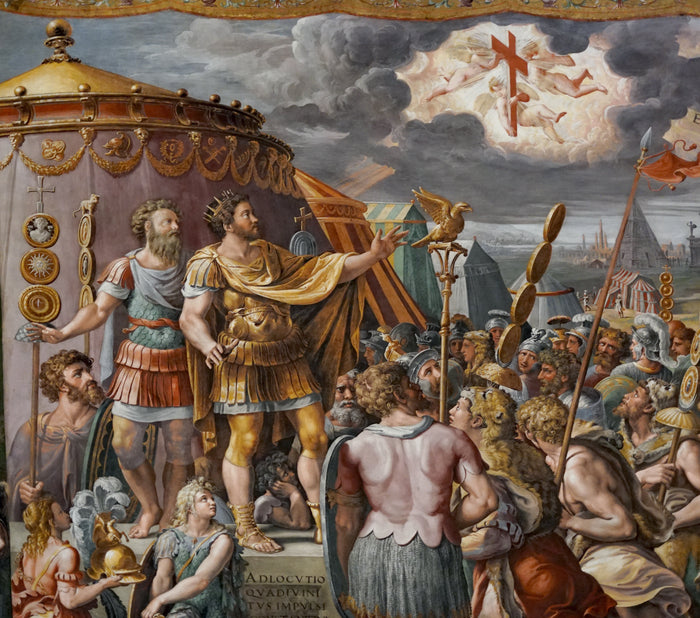
Our Christ the King wall art is printed on matt, uncoated deluxe paper of 216 to 270 g/m², in A5 and A4, without a frame. The prints are not rolled but placed by hand in a protective envelope.
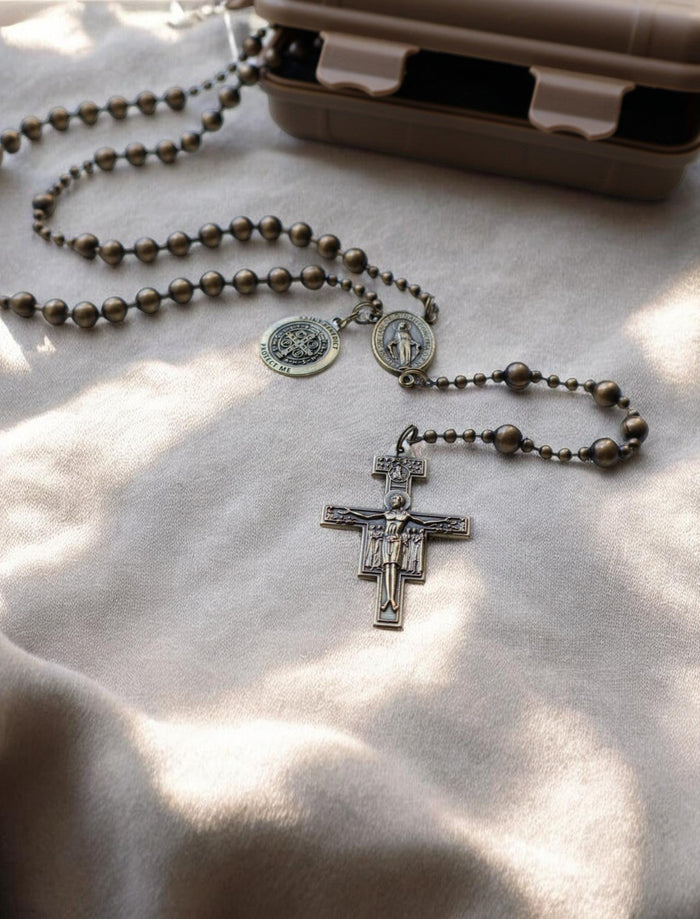
The Soldier of Christ Rosary is knotted from black 4 mm 550 paracord, with bronze-coloured 10 mm metal beads, a Miraculous Medal as the centrepiece and a Pardon Crucifix. Including the crucifix it measures about 51 cm. We knot the spacing between the beads so that your thumb fits comfortably in between; closer or wider spacing is possible on request. You will find further models among our paracord rosaries from the workshop.
 Mentioned in this article
Christ the King wall art, black/beige
Christ as King, printed on matt deluxe paper, supplied without a frame.
View the wall art
 Mentioned in this article
Soldier of Christ Paracord Rosary
Hand-knotted from 550 paracord, with metal beads, Miraculous Medal and Pardon Crucifix.
View the rosary
Frequently asked questions about Christ the King
Is Christ the King a holy day of obligation?
The 1917 Code of Canon Law does not name Christ the King separately as a holy day of obligation. Can. 1247 § 1, however, counts all Sundays among the days of obligation, and Christ the King always falls on a Sunday. On this day, therefore, Holy Mass must be heard (can. 1248), and the Sunday rest applies.
What is the liturgical colour of Christ the King?
Christ the King is celebrated in white. The 1962 rubrics prescribe white for all feasts of Our Lord, except the feasts of his Passion and of the instruments of the Passion (Rubricae generales, no. 120).
What does Christus vincit, Christus regnat, Christus imperat mean?
Christus vincit, Christus regnat, Christus imperat means: Christ conquers, Christ reigns, Christ commands. The 1962 Roman Missal expressly names the hymn Christus vincit as a chant in honour of Christ the King that the faithful may sing during the procession of palms.
How can you keep the Feast of Christ the King at home?
Christ the King is kept first of all by attending Holy Mass. Pius XI also wished the consecration to the Most Sacred Heart of Jesus to be renewed on this day, and a family can pray this consecration together. If you would like to close the day with the Rosary, you will find all the prayers in our Rosary prayer companion, and images of our Saviour among our wall art of Jesus Christ.
- Pius XI: Encyclical Quas primas on the Feast of Our Lord Jesus Christ the King, 11 December 1925, AAS 17 (1925), pp. 593 to 610. Latin and English on vatican.va; paragraph numbering follows the English version.
- Missale Romanum, Editio typica 1962: Dominica ultima octobris, D. N. Iesu Christi Regis, nos. 3938 to 3949; Praefatio de D. N. Iesu Christo Rege; Rubricae generales nos. 17, 91, 115 and 120; rubric for the procession of palms, no. 20. Digitised copy on archive.org.
- Leo XIII: Encyclical Annum sacrum, 25 May 1899. vatican.va
- Codex Iuris Canonici of 1917, can. 1247 and 1248. codex-iuris-canonici.de
- Translations from the Latin by our editors; Bible references follow the Vulgate, English Bible quotations the Douay-Rheims version.
Last checked: 19 October 2026.
The MarcellusOnlineShop workshop
We knot our rosaries by hand in our workshop in Germany and write in our Guide about prayers, devotional items and the traditional Catholic faith.