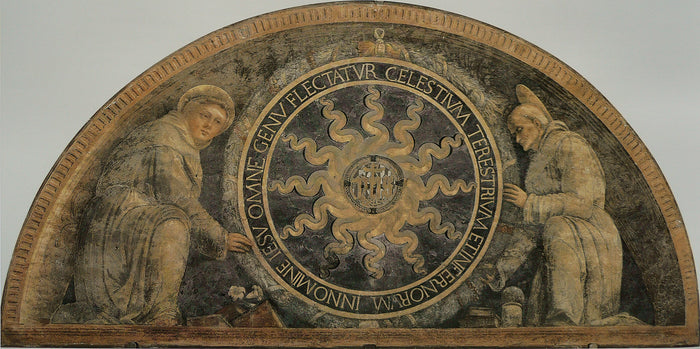
Chaplet of St Michael the Archangel: Order, Prayers and Indulgence
Nine salutations to the nine choirs of angels, each with one Our Father and three Hail Marys: how to pray the Chaplet of St Michael the Archangel, with the petitions after the Raccolta.
Nine Our Fathers, twenty-seven Hail Marys and nine short petitions, each addressed to one choir of angels, followed by four Our Fathers at the end: that is how the Chaplet of St Michael the Archangel is built. The Raccolta, the Roman collection of indulgenced prayers, calls it the Angelical Crown. Pope Pius IX enriched it with indulgences on 8 August 1851 by a decree of the Congregation of Rites. This guide shows the order step by step, gives the nine petitions and the closing prayers, and explains what the name Michael means.
- The Chaplet of St Michael the Archangel is a prayer of nine salutations to the nine choirs of angels, each with one Our Father and three Hail Marys, followed by four Our Fathers at the end.
- Pius IX granted it indulgences on 8 August 1851; the Raccolta of 1910 lists it under no. 291.
- For the indulgences, the Raccolta required a chaplet of its own, blessed for this purpose. The Angelical Crown can also be prayed on the fingers.
- The name Michael means “Who is like God?”, in Latin Quis ut Deus.
What is the Chaplet of St Michael the Archangel?
The Chaplet of St Michael the Archangel is a devotional prayer of nine salutations. Each salutation consists of one Our Father, three Hail Marys and a petition imploring a particular grace through the intercession of St Michael and of one of the nine choirs of angels.
The petitions descend from the highest choir, the Seraphim, to the Angels, who stand closest to men. What is asked for is spiritual throughout: charity, humility, obedience, perseverance in the faith. At the end come four Our Fathers in honour of the Archangels Michael, Gabriel and Raphael and of one’s own Guardian Angel, then an antiphon and a collect.
The names of the choirs come from Holy Scripture; St Thomas Aquinas names the passages: the Seraphim in Isaias 6:2, the Cherubim in Ezechiel, Thrones, Dominations, Virtues, Powers and Principalities in St Paul (Eph 1:21; Col 1:16), the Archangels in the Epistle of St Jude, verse 9 (Summa theologiae I, q. 108, a. 5). With the ordinary Rosary of the fifteen mysteries, the Angelical Crown shares the Our Father and the Hail Mary; it does not have the division into decades or the meditation on the mysteries.
Where does the Chaplet of St Michael come from?
The Chaplet of St Michael is attested by a decree of the Congregation of Rites of 8 August 1851, by which Pope Pius IX enriched it with indulgences. That is how the English editions of the Raccolta of 1878 and 1910 record it.
We have found no older evidence for the Angelical Crown in the pre-conciliar sources. The Raccolta names neither an author nor a history of its origin. It records the prayer with the indulgences Pius IX granted to it in 1851, and with the instruction to use a chaplet of its own, blessed for the purpose. We therefore do not repeat stories about its origin that cannot be verified from these sources.
How do you pray the Chaplet of St Michael the Archangel?
You begin the Chaplet of St Michael the Archangel with the invocation “O God, come to my assistance” and the Glory Be. Then follow nine salutations, each with one Our Father, three Hail Marys and a petition, and afterwards four Our Fathers, an antiphon and a collect.
- Opening with the versicle from Psalm 69:2 and the Glory Be.
- Nine salutations, each with one Our Father, three Hail Marys and the petition of the choir from the table.
- Four Our Fathers: in honour of St Michael, St Gabriel, St Raphael and one’s own Guardian Angel.
- Antiphon, versicle and collect to St Michael.
V. Deus, in adjutorium meum intende. R. Domine, ad adjuvandum me festina.
V. O God, come to my assistance. R. O Lord, make haste to help me. Glory be to the Father, and to the Son, and to the Holy Ghost. As it was in the beginning, is now, and ever shall be, world without end. Amen.
Ps 69:2 after the Vulgate; English and the Glory Be in the traditional form
The nine petitions run as follows, rendered after the Raccolta of 1910, no. 291. Each begins with the words “By the intercession of St Michael and”:
| Salutation | Choir | Petition |
|---|---|---|
| 1 | Seraphim | … the heavenly choir of the Seraphim, may God make us worthy to receive into our hearts the fire of his perfect charity. Amen. |
| 2 | Cherubim | … the heavenly choir of the Cherubim, may God grant us the grace to forsake the ways of sin and to follow the path of Christian perfection. Amen. |
| 3 | Thrones | … the holy choir of the Thrones, may God pour into our hearts a true and sincere spirit of humility. Amen. |
| 4 | Dominations | … the heavenly choir of the Dominations, may God grant us the grace to master our senses and to correct our disordered passions. Amen. |
| 5 | Powers | … the heavenly choir of the Powers, may God keep our souls from the snares and temptations of the devil. Amen. |
| 6 | Virtues | … the choir of the admirable heavenly Virtues, may Our Lord keep us from falling into temptation and deliver us from evil. Amen. |
| 7 | Principalities | … the heavenly choir of the Principalities, may God fill our souls with the spirit of true and heartfelt obedience. Amen. |
| 8 | Archangels | … the heavenly choir of the Archangels, may God grant us the gift of perseverance in the faith and in all good works, that we may attain to the glory of Paradise. Amen. |
| 9 | Angels | … the heavenly choir of the Angels, may God grant that the holy Angels protect us in this life and after death lead us into the eternal glory of heaven. Amen. |
O Michael, glorious prince, chief and champion of the heavenly hosts, guardian of the souls of men, conqueror of the rebel angels, steward of the palace of God, our worthy leader under Jesus Christ, endowed with superhuman excellence and might: graciously deliver from every evil us who have recourse to thee with full confidence, and by thy mighty protection grant that we may advance every day in the faithful service of our God.
V. Pray for us, most blessed Michael, Prince of the Church of Jesus Christ. R. That we may be made worthy of his promises.
Let us pray. Almighty and everlasting God, who in thy wondrous goodness and mercy, for the common salvation of men, didst choose the glorious Archangel Michael to be the prince of thy Church: make us worthy, we beseech thee, to be delivered by his kindly protection from all our enemies, that at the hour of our death none of them may approach to harm us, and that we may be led by the same Archangel Michael into the presence of thy high and heavenly Majesty. Through the merits of Jesus Christ our Lord. Amen.
Antiphon, versicle and collect: our rendering after The Raccolta, London 1910, no. 291, p. 263
Which indulgences did Pius IX grant for the Chaplet of St Michael?
For the Chaplet of St Michael, the Raccolta of 1910 recorded under no. 291 an indulgence of seven years and seven quarantines, one hundred days daily for carrying the chaplet, and plenary indulgences once a month and on five feasts of the angels.
The 1878 edition explains the conditions in more detail. The partial indulgence of seven years and seven quarantines, that is, seven periods of forty days, was gained each time one prayed the Angelical Crown at least with a contrite heart and devoutly. As for every indulgence, the Raccolta presupposed the state of grace, the intention of gaining the indulgence and the exact fulfilment of the conditions.
The Raccolta granted one hundred days daily to those who carried the blessed chaplet with them or kissed the medal of the holy Angels hanging from it. This indulgence, too, did not depend on the object alone, but, like every indulgence, presupposed the state of grace.
The 1878 edition names a plenary indulgence once a month for all who said the prayer daily, being truly contrite, after confession and Communion, and with a prayer for the triumph of Holy Mother Church and the welfare of the Pope; the 1910 edition speaks of prayer for the intentions of the Holy Father.
In addition there were plenary indulgences on five feasts of the angels: on the feast of the Apparition of St Michael on 8 May, which the 1962 Missal lists in the appendix for particular places, on the Dedication of St Michael on 29 September, on the feasts of the Archangels Gabriel and Raphael, and on the feast of the Guardian Angels on 2 October. All details follow the 1878 and 1910 editions of the Raccolta. What an indulgence is, and what it is not, is explained in our guide to indulgences.
What does Quis ut Deus mean?
Quis ut Deus is Latin and means “Who is like God?”. It is the meaning of the Hebrew name Michael. Art often writes these words on the shield of the Archangel, who stands as an armoured warrior over the dragon.
The Catholic Encyclopedia of 1911 explains the name in this way and describes the depiction: helmet, sword and shield, on the shield often the inscription Quis ut Deus, the dragon beneath his feet.
Holy Scripture names Michael in Daniel, in the Epistle of St Jude and in the Apocalypse. In Daniel he is “one of the chief princes” (Dan 10:13), “your prince” (Dan 10:21) and “the great prince, who standeth for the children of thy people” (Dan 12:1). In the Epistle of St Jude, Michael the Archangel disputes with the devil about the body of Moses and says only: Imperet tibi Dominus, “The Lord command thee” (Jude 9). In the Apocalypse, “Michael and his angels” fight against the dragon (Apoc 12:7).
In the 1962 Missal, the Dedication of St Michael stands on 29 September as a feast of the first class. You can read more about the Archangel himself in our guide St Michael the Archangel: meaning, feast and veneration.
Do you need a special chaplet for the Chaplet of St Michael?
To pray the Chaplet of St Michael you need no special chaplet; the salutations can also be counted on the fingers. For the indulgences, the Raccolta required a chaplet of its own, blessed by a priest holding the general faculty of the Holy See to bless rosaries.
Such a chaplet has nine groups of one bead for the Our Father and three beads for the Hail Marys, together with four single beads for the four Our Fathers at the end; according to the Raccolta, a medal of the holy Angels hangs from it. An ordinary rosary of five decades of ten Hail Marys each does not fit this division.
The Raccolta of 1878 states that, by a decision of 4 February 1877, such chaplets must be blessed by a priest who holds from the Holy See the general faculty of blessing rosaries and medals. A rosary bearing the Archangel can nevertheless be combined with the Angelical Crown: you pray the ordinary Rosary and then add the Angelical Crown, counted on the fingers.
We do not make a chaplet with nine groups of three. Our rosaries with St Michael the Archangel are ordinary rosaries with five decades and a centrepiece showing St Michael; on its back it reads “St. Michael Defend us”. We knot the Quis ut Deus rosary from 4 mm 550 paracord in grey and blue, with 10 mm stainless steel Hail Mary beads, 15 mm metal Our Father beads and a Twelve Apostles crucifix. We knot the spacing between the beads so that the thumb fits comfortably in between; if you prefer closer or wider spacing, simply note it in the order notes field.
You will find more models among our paracord rosaries.
 Mentioned in this article
Quis ut Deus paracord rosary
Five-decade rosary in grey and blue paracord, centrepiece with St Michael the Archangel.
To the rosary
Frequently asked questions about the Chaplet of St Michael
How long does the Chaplet of St Michael take?
The Chaplet of St Michael comprises thirteen Our Fathers and twenty-seven Hail Marys, together with the nine petitions, the antiphon and the collect. In Hail Marys, that is a little less than three decades of the ordinary Rosary.
Is the Angelical Crown the same as Leo XIII’s Prayer to St Michael?
The Angelical Crown is a different prayer from the short prayer “St Michael the Archangel, defend us in battle”, which is said after Low Mass. The wording and origin of that prayer are given in our guide Prayer to St Michael the Archangel.
Must the Angelical Crown be prayed daily?
The Angelical Crown is not an obligatory prayer. According to the Raccolta of 1878, daily recitation was the condition for the plenary indulgence once a month; the partial indulgence could be gained with each single recitation.
When is the feast of St Michael the Archangel?
In the 1962 Missal, the feast of St Michael the Archangel falls on 29 September: the Dedication of St Michael, in Latin In Dedicatione S. Michaelis Archangeli, a feast of the first class.
- Ambrose St. John (trans.): The Raccolta, or Collection of Indulgenced Prayers and Good Works, London: Burns & Oates, New York: Benziger 1910, no. 291 “Angelical Crown”, pp. 261–263; On Indulgences, p. x f.; Instructions, p. 1. archive.org
- The Raccolta, or Collection of Prayers and Good Works, English edition 1878, no. 137 “Angelical Crown in Honor of S. Michael the Archangel”, pp. 301–306. archive.org
- Holy Scripture according to the Vulgate: Ps 69:2; Dan 10:13 and 21; Dan 12:1; Jude 9; Apoc 12:7. drbo.org
- St Thomas Aquinas: Summa theologiae I, q. 108, a. 5 and 6. newadvent.org
- Frederick Holweck: St. Michael the Archangel. In: The Catholic Encyclopedia, vol. 10, New York 1911. newadvent.org
- Missale Romanum 1962: 29 September, In Dedicatione S. Michaelis Archangeli, I. classis; 8 May, In Apparitione S. Michaelis Archangeli, in the appendix of Masses for particular places. archive.org
Last checked: 28 October 2026.
The MarcellusOnlineShop workshop
We knot rosaries by hand in our workshop in Germany and write in our guide about prayers, devotional items and the traditional Catholic faith.