Wearing a Rosary as a Necklace: What Canon Law and Tradition Say
There is no prohibition, but there is a clear guideline: what the 1917 Code and Thomas Aquinas say about wearing a rosary around the neck, and which forms the Church provides for it.
Anyone looking for a rosary necklace will mostly find jewellery: necklaces with beads and a cross, offered like a fashion accessory. May you wear a rosary as a necklace? Canon law contains no explicit prohibition. Tradition, however, puts a different question at the centre: why are you wearing it? This guide shows what the 1917 Code and St Thomas Aquinas say on the matter, where the line lies, and which forms the Church provides for wearing on the body.
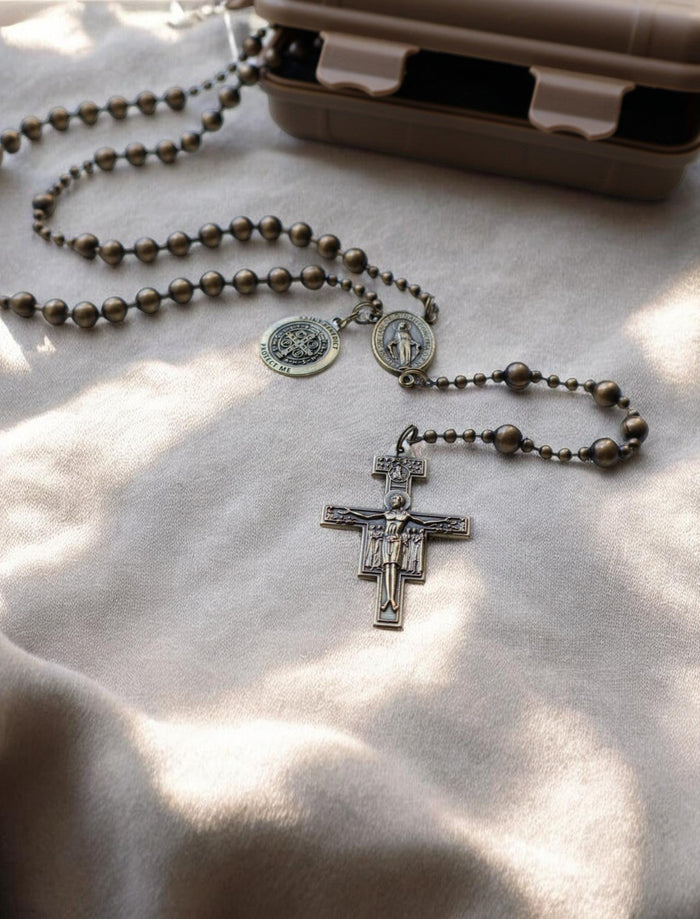
- A rosary is a string of prayer beads: its beads count the Hail Marys of the decades, and the full Rosary of tradition has fifteen decades with 150 Hail Marys. It is made for praying, not for adornment.
- The 1917 Code of Canon Law does not explicitly forbid wearing a rosary around the neck. It requires that blessed objects be treated with reverence and not put to profane use (can. 1150).
- Thomas Aquinas holds that it is lawful to wear sacred words and relics around the neck, provided nothing superstitious is involved and one does not place one’s hope in the manner of tying them on (Summa theologiae II-II, q. 96, a. 4).
- For wearing on the body, tradition has its own signs: the medal and the scapular. The rosary itself can be carried in your pocket, as a finger rosary or in a rosary pouch.
Can you wear a rosary as a necklace?
The 1917 Code of Canon Law does not explicitly forbid wearing a rosary as a necklace. It does, however, require that blessed objects be treated with reverence and not put to profane use. What matters, therefore, is the intention: a string of prayer beads you carry with you, or a piece of jewellery.
Whoever puts a rosary around the neck to have it at hand on the way to Holy Mass, when travelling or at work, and then actually prays it, uses it according to its purpose. Whoever wears it because the beads and cross go well with an outfit, on the other hand, turns a devotional object into an accessory.
We know of no pre-conciliar source that explicitly regulates wearing a rosary around the neck. The answer in this guide is therefore derived: from what a rosary is, from the rule of canon law for blessed objects, and from the teaching of St Thomas on wearing sacred words. A guide cannot, of course, see into the heart.
Is a rosary jewellery?
A rosary is not jewellery but a string of prayer beads. Its beads count the prayers: for each decade one Our Father and ten Hail Marys, and in the full Rosary of tradition fifteen decades, while one meditates on the mysteries of the life of Our Lord and of his most holy Mother.
A decade is a sequence of one Our Father, ten Hail Marys and the Glory Be. The Roman Breviary calls the Rosary “a certain form of prayer” in which one says fifteen decades and, at each of them, recalls in pious meditation one of the mysteries of our Redemption. So the Catholic Encyclopedia of 1912 quotes it. It soberly explains the beads as a counting aid, more convenient than counting on one’s fingers.
From this follows a practical test: a piece of jewellery with a few decorative beads, on which no decade can be prayed, is not a rosary, even if it is called one. How to pray it bead by bead is shown in our Rosary prayer companion.
What does canon law say about blessed rosaries?
Under the 1917 Code of Canon Law, consecrated objects and objects blessed with a constitutive blessing are to be treated with reverence and must not be put to profane or improper use, even when privately owned (can. 1150). According to traditional interpretation, the blessed rosary is among them.
The Latin wording is brief: reverenter tractentur neque ad usum profanum vel non proprium adhibeantur, etiamsi in dominio privatorum sint. The proper use of a rosary is prayer. A use that no longer has anything to do with prayer, such as decoration, a toy or a fashion statement, is foreign to it.
Two further canons help in understanding this. Sacramentals are things or actions which the Church uses in order to obtain, through her intercession, effects chiefly of a spiritual kind (can. 1144). They therefore do not work like a sacrament by virtue of the act performed, but by the power of the Church’s prayers, as the Catholic Encyclopedia of 1912 explains. And indulgences attached to a rosary cease only when it is entirely destroyed or sold (can. 924 § 2). Wearing it alone therefore does not cancel them; the disposition of the wearer nevertheless matters.
What does Thomas Aquinas say about wearing it around the neck?
St Thomas Aquinas holds that it is lawful to wear sacred words around the neck, provided nothing superstitious is involved. It becomes superstitious when one places one’s hope in the manner of writing or tying them on rather than in God. According to Thomas, the same applies to relics.
In the Summa theologiae Thomas treats a related question, de suspensionibus sacrorum verborum ad collum: hanging sacred words around the neck (II-II, q. 96, prologue and a. 4). Excluded are anything that invokes demons, unknown names, falsehoods and vain signs other than the sign of the cross. For relics he answers likewise: if one wears them out of trust in God and the saints, it is lawful. If, on the other hand, one pays attention to vain details, for instance that the case must be triangular, it becomes superstitious.
“Some carry a part of the Gospel written out around their necks. But is not the Gospel read in church every day and heard by all? If the Gospels do a man no good when they are in his ears, how can they save him when hung around his neck? And where is the power of the Gospel: in the shapes of the letters or in the understanding of the meaning? If in the shapes, you do well to hang it around your neck. If in the understanding, then the Gospels profit more when laid up in the heart than when hung around the neck.”
Opus imperfectum in Matthaeum, formerly attributed to St John Chrysostom; quoted by Thomas Aquinas, S. th. II-II, q. 96, a. 4. Our translation from the Latin
Thomas adds that the author is speaking of the case in which one pays more attention to the written characters than to their meaning. Applied to the rosary: it profits through prayer and trust in God, not through merely hanging it around the neck.
When does a rosary necklace become a problem?
A rosary necklace becomes a problem when the rosary serves only as jewellery or a fashion statement, when an effect of its own power is ascribed to it, or when it is worn on occasions that contradict reverence for what is holy.
As to the first case: whoever wears the rosary but never prays it wears a sign without its content. The second case touches the boundary of superstition that Thomas drew: it is not the string that achieves anything, but God who hears the prayer of the Church and of the one who prays.
There is also a practical side. Our product descriptions note that long cords and chains can pose a risk of strangulation. Because of small parts that could be swallowed, a rosary is also not suitable for children under three. If you wear a rosary around your neck, it is therefore better to take it off when sleeping, doing sport or working with machinery.
What are the alternatives to a rosary necklace?
If you wish to wear a sign of the faith around your neck, tradition has its own forms: the medal, for example the Miraculous Medal, and the scapular. The rosary itself can be carried in your trouser pocket, as a small finger rosary or protected in a rosary pouch.
The Miraculous Medal goes back to the apparitions that St Catherine Labouré received in Paris in 1830. The Archbishop of Paris approved the medal, and in 1894 Leo XIII instituted a feast of its own for the Lazarists, which other communities obtained on request. According to her account, great graces were promised to those who wear the medal blessed.
The small scapular consists of two pieces of woollen cloth joined by two strings that rest on the shoulders; one piece hangs on the breast, the other on the back. Since a ruling of the Holy Office of 16 December 1910, anyone validly invested with a small scapular may replace it with a metal scapular medal, blessed by a priest with the appropriate faculty, bearing the Most Sacred Heart of Jesus on one side and Our Lady on the other.
For the rosary itself there are two handy forms: finger rosaries with one decade, and rosary pouches, in which even a large rosary is protected on the go.
For several of our rosaries the description states whether they fit over the head. On the St Benedict paracord rosary, about 56 cm long including the cross, the loop fits over most heads. On the ebony and the sandalwood rosaries the circumference is not large enough. The Combat Rosary Soldiers Edition has a stainless steel ball chain whose circumference is sufficient for wearing around the neck.
Our finger rosary is knotted from 4 mm 550 paracord, with 10 mm metal Hail Mary beads, a 12 mm Our Father bead, a Pardon Crucifix, which goes back to a rescript of Pius X of 1905, and a St Benedict medal. It fits in your trouser pocket, can be attached with a carabiner or worn on the wrist. The sturdy rosary pouch measures 13.5 by 10 by 2 cm, weighs 30 g and holds large and small rosaries alike.
 Mentioned in this article
Paracord Finger Rosary, bronze/black
One decade for your pocket, hand-knotted from 550 paracord, with Pardon Crucifix and St Benedict medal.
View the finger rosary
 Mentioned in this article
Sturdy Rosary Pouch, sand
Made of hard-wearing 1000D nylon, 13.5 by 10 cm, for large and small rosaries.
View the pouch
Frequently asked questions about rosary necklaces
Is it a sin to wear a rosary as a necklace?
Whether wearing a rosary as a necklace is a sin depends on the intention and the circumstances. Worn devoutly, it is permitted; a blessed rosary worn merely as jewellery contradicts the reverence that can. 1150 requires. If in doubt, ask your confessor.
Can a man wear a rosary around his neck?
The same principles apply to men as to women where the rosary is concerned. If you are looking for a strong rosary for daily use, you are more likely to find it among sturdy paracord rosaries than among jewellery chains with delicate links.
Does a rosary lose its indulgences if you wear it?
A rosary to which indulgences are attached loses them, under can. 924 § 2, only when it is entirely destroyed or sold. Wearing it alone does not make them cease. It must nevertheless still be treated with reverence.
How long must a rosary be to fit over the head?
Whether a rosary fits over the head depends on the circumference of the loop, not on the length alone. On the St Benedict paracord rosary (about 56 cm including the cross), the lava stone rosary (55 cm) and the Stella Maris rosary (51 cm), the loop fits over most heads according to the description.
- Codex Iuris Canonici of 1917, can. 924 § 2, 1144 and 1150. codex-iuris-canonici.de
- Thomas Aquinas: Summa theologiae II-II, q. 96, a. 4, with the quotation from the Opus imperfectum in Matthaeum. corpusthomisticum.org
- The Catholic Encyclopedia: “Rosary” (vol. 13, 1912), with the definition of the Roman Breviary. newadvent.org
- The Catholic Encyclopedia: “Scapular” (vol. 13, 1912), with the ruling of the Holy Office of 16 December 1910 (Acta Apostolicae Sedis III, 22). newadvent.org
- The Catholic Encyclopedia: “Sacramentals” (vol. 13, 1912). newadvent.org
- The Catholic Encyclopedia: “Miraculous Medal” (vol. 10, 1911). newadvent.org
- MarcellusOnlineShop product information on length, circumference, material and safety, as of 19 October 2026.
Last checked on 19 October 2026.
The MarcellusOnlineShop workshop
We knot rosaries by hand in our workshop in Germany and write in our guide about prayers, devotional articles and the traditional Catholic faith.