The Cross of St. Benedict: Meaning, Symbolism, and Protective Power
The Cross of St. Benedict is one of the Church’s most powerful symbols of protection. Learn what the symbols mean and how to use it in your faith
A small metal cross, barely larger than a coin. When you hold it in your hand for the first time , all you see at first are letters densely engraved on the crossbars and the rim. But these abbreviations are not merely decorative: The Benedictine Cross contains a complete Latin prayer, a formula of protection against evil, and a profession of faith in Christ. It is a devotional object blessed by the Church and one of the most significant symbols of protection in the Catholic tradition.
In this article, you’ll learn where the Cross of St. Benedict comes from, the story behind the rediscovery of its inscriptions, what each individual letter means, and how to use it properly in your daily spiritual life.
Contents of this article:
Saint Benedict of Nursia
Benedict of Nursia was born around 480 A.D. in central Italy. He founded the Monte Cassino Abbey and authored the *Regula Benedicti*, the monastic rule that would shape monastic life in Western Europe for over fifteen centuries. On October 24, 1964, Pope Paul VI declared him the patron saint of Europe in the Apostolic Letter *Pacis nuntius* and called him the “Father of Western monasticism.”
The History of the Church, recorded by Pope Gregory the Great around 592, reports on two events that are depicted on the Medal of St. Benedict. Enemies sent Benedict a poisoned chalice. When he made the sign of the cross over it , the chalice shattered. On another occasion, an adversary sent poisoned bread; a raven is said to have carried it away before Benedict could touch it. Both motifs appear on the front of the 1880 jubilee medal: the broken chalice on the right and the raven with the bread on the left next to the figure of the saint.
“Listen, O child, to the instructions of your master, and incline the ear of your heart.”
St. Benedict of Nursia, Prologue to the Rule of St. Benedict
The Rediscovery of the Blessing: Metten Abbey, 1647
The sequence of letters on the Cross of St. Benedict is very old, but its meaning remained unknown for a long time . In 1647, six women were on trial for witchcraft in Straubing, Bavaria. During the interrogations, they claimed to have had no power over the nearby monastery in Metten because the Benedictine Cross was hidden there. An investigation of the monastery did indeed reveal murals featuring the characteristic sequence of letters.
At first, the monks of Metten were unable to explain the meaning of the letters. It was only in the monastery library that they found a codex from the year 1415, which, in addition to a depiction of the blessing, also contained a complete explanation of the initials. This clarified the meaning of the Benedictine blessing. The cross, therefore, had not been created in 1647, but had been rediscovered at that time and explained publicly for the first time.
In 1880, the monks of Monte Cassino minted a standardized jubilee medal to mark the 1,400th anniversary of the birth of St. Benedict. The design originated at the Archabbey of Beuron. This design remains the standard to this day and serves as the basis for all commonly available St. Benedict medals.
The Symbols and Their Meanings
Each letter on the Benedictine medal stands for a Latin word. Together , they form a complete prayer. Those who know these symbols are not wearing a silent piece of metal, but rather a spoken creed in condensed form.
On the Crossbeams: The Core Prayer
The vertical beam bears the letters C S S M L, standing for *Crux Sacra Sit Mihi Lux*: “May the Holy Cross be my light.” The horizontal beam bears the letters N D S M D, standing for *Non Draco Sit Mihi Dux*: “May the dragon not be my guide.” At the four corners of the cross are the letters C S P B for Crux Sancti Patris Benedicti: “The Cross of the Holy Father Benedict.” Above the cross is PAX, “Peace,” the traditional motto of the Benedictine Order.
In the margin: Vade retro, Satan
The edge of the reverse side is inscribed with the sequence of letters V R S N S M V S M Q L I V B, the initials of an exorcistic protective formula: Vade retro Satana! *Nunquam suade mihi vana! Sunt mala quae libas, ipse venena bibas! * In English: “Be gone, Satan! Never tempt me with vanity! What you offer me is evil. Drink your own poison !" These words form a traditional exorcistic formula of defense from Church tradition. They are not to be equated with the solemn ecclesiastical exorcism performed on a person, but rather a prayer for personal protection against evil.
The Christogram IHS
On older medals, the Christogram IHS sometimes appears above the cross. It derives from the first three letters of the Greek name for Jesus (iota, eta, and sigma from ΙΗΣΟΥΣ). The Latin interpretation as Iesus Hominum Salvator, “Jesus, Savior of Mankind,” is a common, but later interpretation that exists alongside the Greek origin.
| Abbreviations | Latin | German |
|---|---|---|
| CSPB | The Cross of Saint Benedict, the Father | Cross of St. Benedict, the Holy Father |
| CSSML | May the Holy Cross Be My Light | May the Holy Cross be my light |
| NDSMD | Let Not the Dragon Be My Guide | "The dragon is not my guide" |
| VRSNSMV SMQLIVB | Vade retro, Satan… (exorcism formula) | Get away, Satan… |
| PAX | Pax | Peace (Motto of the Order) |
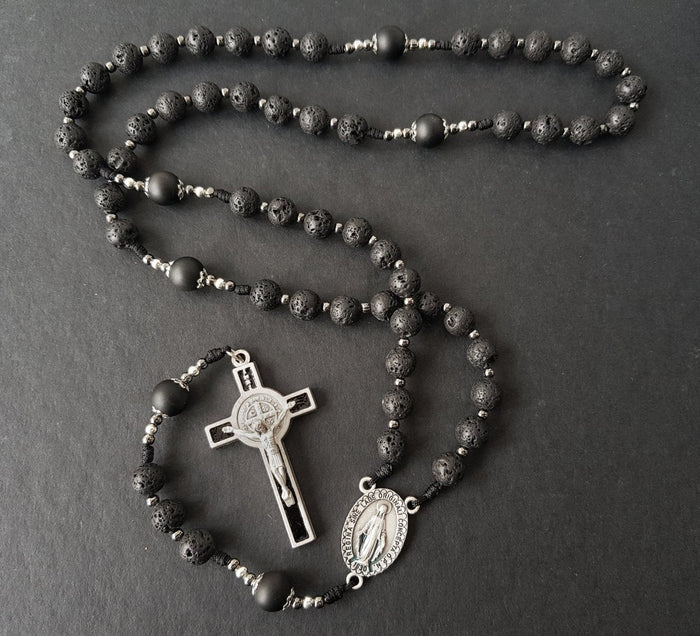
The medal is found in many handmade rosaries as a centerpiece or cross pendant. A paracord rosary with a St. Benedict medal combines durability and elegance with deep spiritual significance and is suitable for both daily use and special occasions.
An object of devotion, not a talisman
The St. Benedict Medal is a religious devotional object, not a good-luck charm. The Benedictine Order expressly states that religious objects should not be used as amulets with magical powers of their own. Through the church’s blessing, the medal becomes a blessed devotional object. Its use does not automatically produce results, but requires faith and a corresponding inner attitude.
In 1742, Pope Benedict XIV, through a papal breve, linked certain indulgences to the wearing of the medal. A decree of the Sacred Congregation of Rites dated March 6, 1959 permits the blessing of St. Maurus to be imparted to the sick using a St. Benedict medal, since relics of the True Cross are difficult to access.
The St. Benedict Medal is thus part of a long tradition of church-approved devotional items. Like the blessed rosary, it reveals its meaning through conscious, devout use.
How to Use the St. Benedict Medal Correctly
Tradition does not specify any church-prescribed way of wearing it. The following forms of use are common :
- Blessing by a Priest or Deacon
The medal may be blessed by a priest or, if the liturgical rite so provides, by a deacon. The person performing the blessing does not have to be a Benedictine. The corresponding blessing rite for the St. Benedict Medal is specifically provided for in the Church.
- Wear it on your body or on a rosary
The medal can be worn as a pendant or attached to a rosary . When praying the rosary, the medal is usually held at the beginning, while the beads are counted for each prayer. A paracord rosary with a St. Benedict medal combines two of the Church’s oldest prayer symbols in a handcrafted piece made with quality and attention to detail.
- Placing It in the Home
Whether on a doorframe, above the entrance, or in the bedroom, the St. Benedict medal is a natural part of domestic piety in many Catholic households. Tradition also includes the custom of embedding the medal in the foundation when a house is being built.
- Wearing It Consciously and Faithfully
Those who know the inscriptions and understand the medal as a silent, enduring prayer are wearing more than just a symbol. They are wearing a profession of faith: that the cross of Christ may be their light and no other path their guide.
Also available in the store:
Paracord rosaries with a St. Benedict medal: handcrafted from genuine 550 paracord, cadmium-free and lead-free.
All Rosaries at a Glance: Paracord, semi-precious stones, wooden beads, and glass beads—all crafted with care and dedication.
Frequently Asked Questions
What does the Cross of St. Benedict mean?
The Benedictine Cross is a blessed devotional object engraved with the Latin initials , which form a complete prayer. It bears the inscriptions “Crux Sacra Sit Mihi Lux / Non Draco Sit Mihi Dux” on the crossbar, as well as the exorcism “Vade retro Satana” on the rim. Its power is not automatically activated, but rather through conscious, devout use.
What is the difference between the St. Benedict Medal and the St. Benedict Cross?
The St. Benedict Medal is usually round and features the typical symbols and inscriptions on both the front and back. The St. Benedict Cross often refers to a cross or crucifix into which the medal is set. Both forms bear the same inscriptions and are blessed and worn in the same way.
Does the St. Benedict Medal need to be blessed?
Through the ecclesiastical blessing, the medal becomes a blessed devotional object. The blessing may be performed by a priest or, where the liturgical rite so provides, by a deacon; the person performing the blessing does not have to be a Benedictine monk. An unblessed medal is a meaningful sign of faith; the blessing adds the ecclesiastical dimension of a devotional object to it.
What does " Vade retro Satana" mean?
The complete formula is: Vade retro Satana! Nunquam suade mihi vana! Sunt mala quae libas, ipse venena bibas! Translated: “Be gone, Satan! Never tempt me with vanity! What you offer me is evil. Drink your own poison!” This is a traditional exorcistic formula of defense, not a solemn ecclesiastical exorcism performed on a person.
Who declared St. Benedict the patron saint of Europe?
On October 24, 1964, Pope Paul VI declared St. Benedict of Nursia the patron saint of Europe through the Apostolic Letter *Pacis nuntius *. In the same document, he referred to him as the “Father of Western Monasticism.”
The St. Benedict Medal is a symbol of faith and protection against evil. Discover handmade rosaries that feature it as their centerpiece, crafted with care and devotion.
Discover paracord rosaries nowRemember to have your St. Benedict medal and rosary blessed by a priest before using them .