Devotional Items: Meaning, Tradition, and Origins Explained
Rosenkranz, Kreuz, Medaille, Heiligenbild: Was Devotionalien sind, woher der Brauch kommt und warum erst die Weihe durch den Priester sie zum Sakramentale macht.
Crosses, rosaries, images of saints, and medals have been part of the daily lives of devout Catholics for centuries. They are called devotional objects, but very few people know exactly what this term means or how it differs from related religious terms.
In this article, we explain the origins, significance, and tradition of devotional objects, distinguish them from sacramentals, and provide an overview of the various categories of traditional Catholic devotional objects.
Contents of this article:
What does the term "devotional items" mean?
The word “devotional” comes from the Latin *devotio*, which means “devotion” or “reverence.” Devotional items are objects used for personal religious devotion and to foster piety. These include, among other things, crosses, crucifixes, rosaries, statues of saints, devotional images, icons, and medals with religious motifs.
Devotional items accompany the faithful in their daily prayers as well as on special occasions. A rosary carried with you or a cross above your bed are visible signs of faith in everyday life. They are meant to help people feel close to God, Mary, and the saints, and at the same time serve as an expression of a prayer or an ongoing intention.
A devotional object is an item used for religious devotion and personal piety, without itself being part of the church's liturgy.
It is important to distinguish this from superstition and magic. A devotional object is not believed to have any automatic supernatural effect, as would be the case with a talisman. Rather, it is an expression and symbol of the wearer’s attitude of prayer, hope, and trust.
Devotional Items and Sacramentals: The Difference
In discussions about Catholic devotional items, two terms often come up that are easily confused: devotional items and sacramentals. The two are related, but they do not mean the same thing.
According to the Church’s understanding, sacramentals are sacred signs instituted by the Church itself that, in a certain sense, imitate the sacraments and signify spiritual effects. Unlike the sacraments, whose effects occur ex opere operato, sacramentals operate ex opere operantis—that is, on the basis of the Church’s prayer of consecration together with the faith of the recipient. A devotional object does not necessarily have to be blessed by the Church to be considered as such. However, once a devotional object is specifically consecrated or blessed by the Church, it is classified as a sacramental.
In practice, many believers have their devotional objects blessed, thereby giving them a firm place within the Church’s sacramentals, without the objects themselves becoming part of the liturgy. The priest—or, where the liturgical rite so provides, the deacon—is responsible for the blessing.
Tradition and History of Devotional Items
The custom of carrying devotional objects dates back to the early Church. Small metal crosses with hanging loops, as well as medal-like objects from the Roman catacombs, have been preserved from early Christian times. According to tradition, after her consecration as a virgin, Saint Genevieve of Paris received from Germanus of Auxerre a perforated bronze coin bearing the sign of the cross, which she wore from then on—an early example of a devotional object in the modern sense.
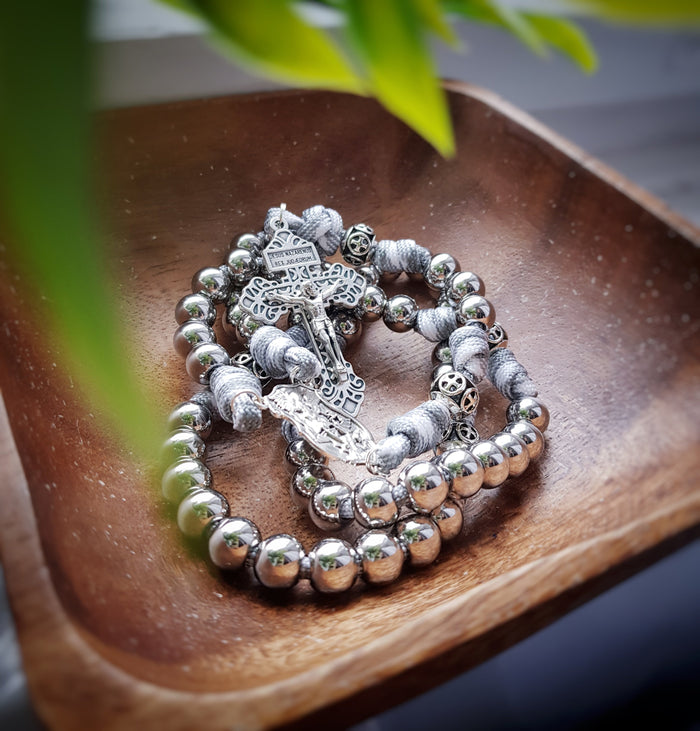
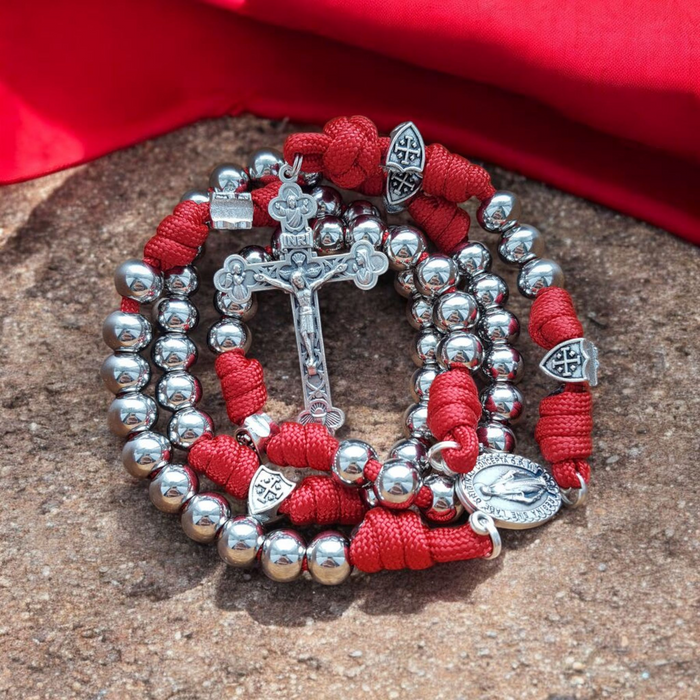
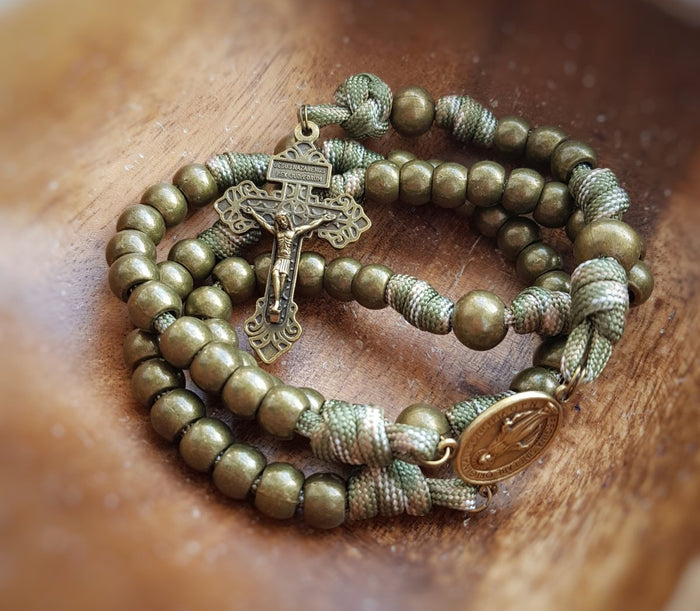
Over the centuries, a distinct trade in devotional items developed around pilgrimage sites. Pilgrims brought home a memento from their journey—be it a cross, a medal, or a devotional image—thus continuing a practice that had already existed in a similar form in antiquity. Today, this tradition continues, even outside of pilgrimage sites, for example through handmade rosaries that are crafted with care and devotion and combine traditional Catholic symbolism with modern craftsmanship.
What kinds of devotional items are there? An overview
There is a wide variety of devotional items. At MarcellusOnlineShop, you'll find the following categories of traditional Catholic devotional items:
- Rosaries: the classic prayer aid, available in a wide variety of styles.
- Paracord rosaries: handcrafted from genuine 550 paracord, sturdy and durable.
- Combat Rosaries: Military-grade quality meets piety, suitable for everyday use.
- Rosaries with stone beads: Semi-precious stones such as obsidian or jasper used as bead material.
- Rosaries with glass beads: a classic, elegant beaded look.
- Rosaries with wooden beads: warm, natural texture.
- Finger rosaries: compact, ideal for travel and for carrying in your pocket.
- Crosses: as wall crosses, pendants, or travel crosses.
- Statues: Depictions of Christ, Mary, and the saints.
- WallArt: Devotional Images and Iconography for the Home.
- Patches: Christian symbols for clothing and gear.
- Memento Mori: Objects that serve as a reminder of one's own mortality.
- Books: Prayer books and literature to deepen one's faith.
- New Arrivals: The latest additions to our product line.
Having devotional items blessed and cared for
Many believers have their devotional items blessed by a priest or deacon. Through this ecclesiastical blessing, the object becomes a blessed devotional item and thus part of the sacramentals. However, its use does not automatically produce results; rather, it requires faith and a corresponding inner attitude on the part of the person using it.
Blessed objects should be treated with reverence and not used for secular purposes, even if they are privately owned. If a devotional object is damaged and beyond repair, tradition dictates that it be burned or buried with dignity, rather than simply discarded.
Also available in the store:
Discover our selection of rosaries —handcrafted with quality and attention to detail.
Frequently Asked Questions
What is the difference between devotional items and sacramentals?
Devotional items are objects used for personal prayer that do not necessarily have to be blessed. Sacramentals are sacred symbols instituted by the Church that, through blessing or consecration, signify a spiritual effect in accordance with the Church’s teachings.
Do I need to have my devotional items blessed?
A blessing is not strictly required, but many believers wish to have one. You can have your devotional items blessed by a priest or, if the rite provides for it, by a deacon, often following Holy Mass.
Where does the term "devotional items" come from?
The term derives from the Latin word *devotio*, which means “devotion” or “reverence.” It has always been used to refer to objects used for religious devotion.
Are devotional items intended only for Catholics?
Devotional items are most deeply rooted in the Catholic tradition, but they are also valued by people of other Christian denominations and as meaningful gifts, such as for First Communion or Confirmation.
Discover our complete selection of traditional Catholic devotional items, crafted with care and devotion.
View the entire product line →Remember to have your devotional items blessed by a priest before using them.