Hail Mary: Text, Meaning, History
Wortlaut auf Deutsch und Latein, die zwei Verse aus dem Lukasevangelium und wie der Englische Gruß 1568 seine heutige Form erhielt: das Ave Maria, Wort für Wort erklärt.
The Hail Mary is, after the Lord’s Prayer, the most frequently recited prayer in Christendom and the heart of the Rosary. Hardly any other text has sustained the piety of the Church over so many centuries as these few lines from the Gospel of Luke.
In this article, you will find the complete text in German and Latin, the biblical origin, the historical development, as well as the meaning of the individual parts of the prayer and their established place in the Rosary.
Contents of this article:
The Text: German and Latin
The "Hail Mary" is recited in the Catholic Church in two languages: in the local language and, especially in the Rosary and the liturgy, in Latin as the Ave Maria. Both versions are presented side by side here.
| German | Latin |
|---|---|
| Hail Mary, full of grace, the Lord is with you. | Hail Mary, full of grace, the Lord is with you. |
| You are blessed among women, and blessed is the fruit of your womb, Jesus. | Blessed are you among women, and blessed is the fruit of your womb, Jesus. |
| Holy Mary, Mother of God, pray for us sinners now and at the hour of our death. Amen. | Holy Mary, Mother of God, pray for us sinners, now and at the hour of our death. Amen. |
The Biblical Origin
The first part of the prayer is not a later addition, but comes verbatim from the Gospel of Luke. At the Annunciation, the Archangel Gabriel appears to Mary and greets her with the words that became the opening lines of the prayer.
"Hail, favored one, the Lord is with you."
Luke 1:28
Shortly thereafter, the pregnant Mary visits her relative Elizabeth. Filled with the Holy Spirit, Elizabeth recognizes the significance of the child and, in turn, offers a blessing that forms the second clause of the prayer.
“Blessed are you among women, and blessed is the fruit of your womb.”
Luke 1:41 ff.
To this day, these two Bible passages form the first, reverent part of the prayer. The name of Jesus at the end of this section was added only in the late Middle Ages to explicitly identify the reference to Christ.
History of Prayer
In this purely biblical form, the greeting was already in liturgical use in the early Church— —in the East from the fourth or fifth century onward, and in the West from the eighth century onward. It was initially used as an antiphon in the Liturgy of the Hours before evolving from the church’s choral prayer into an independent prayer of the people.
In the late Middle Ages, the faithful added a personal request for Mary’s intercession to the biblical greeting—the second part of today’s prayer. Pope Pius V made this addition official in 1568 by including it in the Roman Breviary, thereby establishing the form of the Hail Mary that is still in use today. The close connection between this prayer and the Angelus, as well as the Rosary—which was spreading at the same time—also dates from this period; in the Rosary, the Hail Mary became the most frequently repeated prayer of all.
The Meaning of the Individual Parts
The first part of the prayer is a hymn of praise. It recalls Mary’s election by God and her faithful obedience, which makes her a model for the Church. Those who pray this part are thus recalling a specific, biblically attested event, not merely a formula.
"Gebenedeit" means "blessed" or "praised." It is derived from the Latin benedictus and expresses the idea that Mary was graced by God in a special way.
The second part is a request for intercession, not worship. In the Catholic Church, God alone is worshiped. The faithful ask Mary, as the Mother of God and as an intercessor, to intercede for them before God, just as they ask other saints for their intercession. This request applies to one’s entire life and explicitly also to the final hour of death.
In the Rosary Prayer
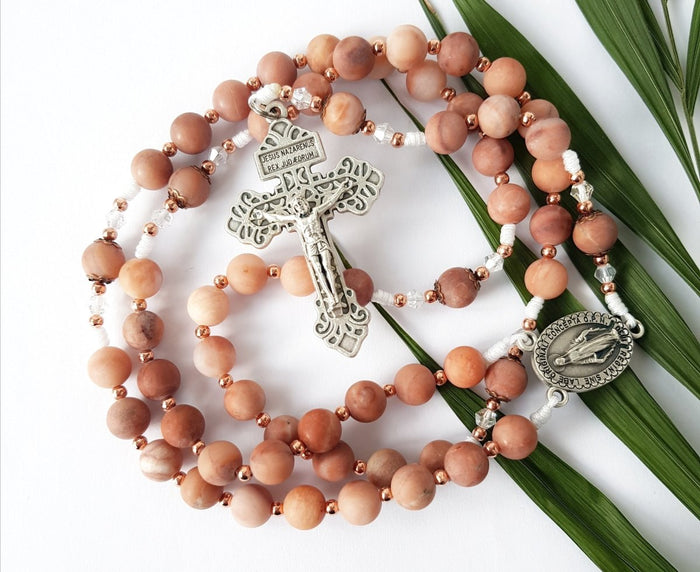
Nowhere do the faithful encounter the "Hail Mary" more frequently than in the Rosary. A complete set of the Rosary consists of five decades, each containing ten Hail Marys, framed by introductory prayers. In total, the Hail Mary is recited fifty-three times, with each individual bead of the Rosary counting as one prayer.
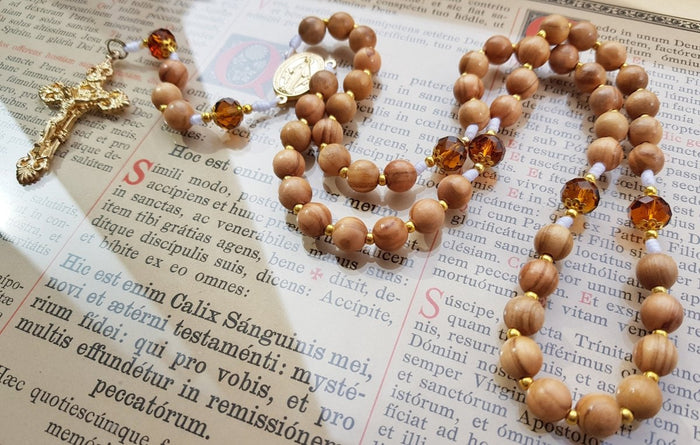
This constant repetition is not an empty formula, but a form of contemplative meditation on the life of Christ. With each Hail Mary, the person praying focuses on one of the mysteries of the Rosary, while the familiar words flow in the background. Those who feel the beads between their fingers often find it easier to attain this sense of peace. This is precisely why the Ave Maria Rosary is handcrafted: as a reliable companion for daily prayer, sturdy enough for daily use, and at the same time dignified enough for special occasions.
Also available in the store:
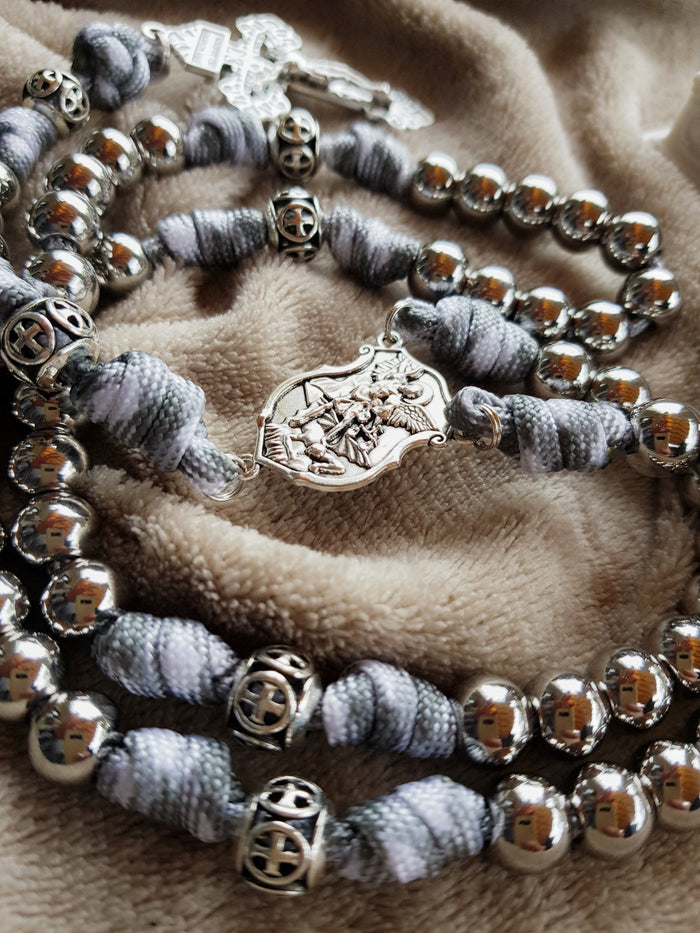
Paracord rosaries made from genuine 550 paracord, cadmium-free and lead-free, crafted with care and dedication for daily Hail Mary prayers.
Frequently Asked Questions
Is “Hail Mary” the same as the “Ave Maria”?
Yes. “Gegrüßet seist du Maria” is the German translation; “Ave Maria” is the Latin version of the same prayer. Both forms are used depending on the liturgical or personal context .
When you pray the Hail Mary, are you praying to Mary herself?
No. God alone is worshiped. In the second part of the prayer, the faithful ask Mary, as the Mother of God, merely for her intercession, just as one also asks other saints for their prayers .
How many times is the Hail Mary recited in the Rosary?
In a complete set of the Rosary with five decades, the Hail Mary is recited fifty-three times—ten times per decade and three times at the beginning of the prayer.
Where does the text of the prayer come from?
The first part is taken verbatim from the Gospel of Luke, from the Archangel Gabriel’s greeting, “ ” (Luke 1:28), and Elizabeth’s blessing (Luke 1:41 ff.). The second part, the request for intercession, was added in the late Middle Ages and officially incorporated into the Roman Breviary by Pope Pius V in 1568.
The Hail Mary has accompanied generations of believers through each bead of the Rosary. Discover our handcrafted rosaries for your daily prayers.
Discover Rosaries →Remember to have your rosary and devotional items blessed by a priest before use .